Showing posts with label Design. Show all posts

Tuesday, June 3, 2025

Dungeon Design Note: Defining Interactivity

A lot of dungeon design advice focuses on “interactivity”, and to a degree this word can be a meaningless substitute for “stuff I personally like”. Yet one should strive to write locations with “interactive elements”. In the context of location based (or dungeon crawl) adventure design interactivity in an adventure means the degree to which there are obstacles and dangers beyond inimically hostile monsters and simple traps. An interactive adventure describes things in the area or room “key” that the players can ask questions about and do stuff with…

STEP INTO THE DUNGEON DRESSING ROOM


Interactive design offers elements of the adventure that aren’t a superstructure for simple die rolls - something beyond simple traps to “save” against and monsters ready to “fight until killed”. The more reliant one’s adventure is on these sorts of purely mechanical challenges the more the RPG becomes a sort of dice and board game. It’s likely that to some degree this was how Dungeons & Dragons was originally envisioned. That the dungeon adventure was originally intended to be played from something like the “zoomed out”, impersonal perspective of a wargame. OD&D reads like this at times, and one can imagine a referee running it who rolls each turn and declares new mechanical challenges or events … “You encounter three Ogres” or “One of your hired footmen falls into a pit trap as you go down the hallway.” Players then roll dice to fight the monster and remove resources such as their missing footman from their sheets, then they collect any treasure, move a few squares on the map and the next turn begins.

To run such an adventure you would need basically a map and set of random encounter tables, or a location with keys like this:

AREA 1
5 Orcs, 50 GP


There’s not a lot for designers to do with this kind of adventure, the dungeon generation tables at the back of the AD&D Dungeon Master’s Guide can generate a decent version of this sort of adventure. However, this isn’t how RPGs have ended up being played by most, not even in the early days of the hobby. Some outliers like Dave Megary’s DUNGEON! and the amazingly charming Rules for the Game of DUNGEON by then teenage Craig VanGrasstek seem to have sprouted from Arneson’s Twin Cities game, but for most, and certainly in 2025, this style of dungeoneering board game is not considered an RPG.

Gygax also recognized this over time and didn’t want to play a board game. The few pages of “Solo Play” dungeon generation tables he originally published in the first issue (Spring 1975) of Strategic Review Magazine were included in the Dungeon Masters Guide as Appendix A, but had added random generation tools in Appendices C, G, H, I, J, K, L, and M - mostly adding description and specifics to the bare halls of the earlier version. Appendix H even includes “Dungeon Dressing” - the sounds, smells, air movements and mundane objects that might be found in a dungeon. This, along with Gygax’s dungeon design, show an appreciation for “interactivity” and a step away from the board game possibilities of early D&D.  Gygax may have written more military or wargame style scenarios then some other designers, but he wasn’t playing a board game like adventure limited to mechanical challenges.
FROM PROCEDURAL GENERATION TO BESPOKE
Of course these type of random tables suffer a lot of issues - the most important being that the more complex randomly generated spaces become the less thematic and interactive they can be… that is the octagonal room filled with ... a feculent smell, mushroom patches, a chasm, 5 orcs and a portcullis trap doesn’t do much more than the ultra-minimalist room. The smells, sounds, trap, and room contents are only incidentally related to the room’s inhabitants and the contents of surrounding rooms. They are disparate descriptive elements that players can interact with by asking questions about, but they don’t “do” or “mean” anything that will help the players. All these sorts of dungeon dressing accomplish is to give a vague sense of the real to the dungeon - it is full of things and fixtures, just like real spaces.

Wednesday, March 26, 2025

Most Adventures are Bad - An Adventure Writing Process

This is an odd post, it’s adventure design advice, specifically dungeon/location based adventure design, but it’s not about specifics, just the process. I have been reading recently published adventures again and I’m not especially impressed. Similarly the recommendations I increasingly see in Post-OSR (often just labelled OSR) spaces are largely for very old adventures from the TSR era. At the same time there’s more new adventures published for OSE, Cairn, and any number of other Post-OSR systems or B/X clones than ever before…

So why do a lot of adventures stink? I mean this, and I promise you my standards are not high, but a lot of what I see published is similar to or worse than the products of forty or fifty years ago - when the idea of the published adventure was still emerging… How can this be? Yes, there are people using “AI” to write and illustrate adventures and flooding DTRPG with them - and they are universally terrible. Also, the barriers to publishing are so low now that there are children publishing childish things, and maniacs hammering out a dungeon in a few drunken hours … I’m not talking about these circumstances. I mean adventures written by people who clearly care, and clearly spent time, but still failed to produce playable adventures…

How does this happen?


I ASK YOURSELF ... WHY IS MY NEW ADVENTURE SO BAD?
Even if it's not. Ask these questions.

  • Am I afraid to use my own ideas, did I just rewrite the simplest, most cliched adventure “as practice”...

  • Did I have some notes from when I ran a cool adventure at my table … and decide drop them into a layout program... 

  • Did I have ideas for each and every room, that are all different and unrelated…

  • Did I decide I couldn’t draw maps, so why bother ? Do I think maps aren’t important…

  • Did I have one cool set-piece idea and couldn’t think of anything for the other 5-25 keyed locations on the map I have “borrowed”... 

  • Have I never played this system before, but figured that every game is basically the same…

  • Did I write a “five room dungeon”...

  • Did I use a random generator to fill the rooms of my dungeon…

  • Did I get bored after the first few rooms and think everything else could just be improvised in play…

  • Did I only want to do one part of the process, like design cool monsters, and rush everything else…

  • Did I even want to write an adventure or did I write a cool history of a fantasy location and grudgingly add a map and key…

  • Have I heard that location based adventures don’t need “stories” or that stories “emerge” from play and take this too literally…

  • Do I have the creativity of a doorknob … or did my “market research” tell me people like bland and cliched adventures the best…


Obviously this isn't an exhaustive list, there are lots of other things to do and things to avoid when writing an adventure. Also recognize that of these mistakes none come from malice or personal defect (even a lack of creativity is something that comes and goes). Mostly mistakes come from fear or misunderstanding of how to design an adventure for publication. Writing adventures is a distinct skill, and it’s not one that’s taught anywhere. It is neither entirely a technical process or entirely a creative one. It is not writing a novel or a screenplay because an adventure (at least the location based adventure) isn’t about a narrative structure.

Saturday, March 8, 2025

Fear in a Handful of Dust

A Brief Barrow Fields Gazetteer


I was born on the Cidro. 
The City of Fountains, back during the war. Devil's pox and the proscriptions took most of my family. Left my poor mother, my brothers and me. So I headed north to prospect with the Blockers, they were robbing gems on the Crystal Frontier. In the poisoned dark among the tombs and the haints, were many a young man who took leave of his life.  I could see the blood on the crystal where others had died. I took myself away in the year '85.
 
Here's where I stopped, in the cool shadows of the great silent mounds.
 The skills that I learned in the gem mirrored halls have served me well here year after year. Most the old dead rest easy, among their bronze and their silver, and I've built a life from their bones and misfortune. But it's all cut and dried now.  I  came off moor when we diggers were kings.
- Robero Dulce, 86, Digger

The Bone Lands, Barrow Fields, Moors Dolorous, the Big Dig … a fragment of the Frontier that stands apart, on the lee slope of the Maiden Tombs.  Soil gone cursed and acidic, but still wetted by downslope fog, the land’s pastures have long transformed into gray moor. Grim and drab, it is a landscape of darting brindled hares, twisting scrub oaks, obscene lichen, spider-faced black vipers, and skeletal euphorbia bramble. Persisting among the moor’s wrack, the legacy of ancient times and ancient death. Everywhere. Bone fragments in the gravel, sigil stones tangled in briar, empty cists open in the sod and the stone topped barrows that loom from the obscuring mist.

This connection to the deep past sets the Bone Lands apart from the rest of the Crystal Frontier, while their uninhabitable harshness makes them just as much an unclaimed waste. The Barrow Fields are a fragment out of ancient day, a heroic age before the Sky Tombs began to plummet in fire from the firmament bringing poison and wonder. Before the Warlock King staked a claim on behalf of Kosse Sildar’s people and brought a new war and new kinds of terror to replace the old. Before even old Kosse Sildar’s and its pompous, chivalric insistence that it was not a servant to the Empire across the mountains to whom it tithed a conqueror’s share of its wealth.


This is no argument for the glory of the Barrowland’s past. Write no poems on the glory of an age undreamed of. The ancients rotted the land as thoroughly as The Warlock King’s demon hosts, Kosse Sildar’s excesses, the Empire’s casual plundering, or the chromatic blight that leaks from the Sky Tombs. Acid soil, haunts, and foul beasts are not the only legacy written on the land by the Chariot Kings and Palace Queens of old, but they are of a lot with the rest. The hulking barrows, deep pits, and stone dolmens contain silver baubles, green bronze, mountains of ancient bones … all tainted with hard death, and blood sorcery.


Geographically the Barrow Fields remain a strip of land some marches deep that runs across much of the northern Frontier, just beyond the foothills, from the Emperor’s Ribbon to the river. They straggle down toward deep desert, ending in a series of rugged bluffs near the Silver Highway to Old Argento. For the discerning Gem Robber however, they are a “hole in the map”, largely free of fallen crystals and occulith, but full of a particularly distasteful sort of danger that makes them unworthy of notice.

In the Bone Lands they feel different of course, everywhere has its local pride. Pride in the least of things. For the hardy few of the Bone Lands that’s pride in hard graft and the desecration of the ancient tombs. There is one valuable that the desolate moors are rich in…the ageless dead. The men and women of the Barrow Fields, proudly proclaim the title “digger”, and mine time yellowed bones by the ton … for ancient bone, steeped in rotten spellery has no modern equal as sorcerous fertilizer. Throughout the Empire, “Maiden Tomb Bone” or “Barrow Meal” is a panacea for the ongoing agricultural decline. In the failing fields of Green Hive, Syndicators plow it under to revive alchemically enhanced crops and in the gardens of Dawn Rill the gardeners feed their prize topiary on the Barrow lands’ residual magic.


Saturday, March 1, 2025

AN INTRODUCTION TO DUNGEON CRAWLING

You want to run a “Dungeon Crawl” adventure Not just an adventure in a "dungeon", but a Dungeon Crawl - that distinct, classic mode of RPG play about exploring a fantastical space, obtaining its treasures, and unraveling its secrets ... while surviving its dangers. Notably, the first rule of Dungeon Crawls is that surviving dangers does not always mean destroying or even overcoming them.

Dungeon Crawls should emphasize the tense experience of exploring a wondrous and dangerous location. These adventures will be more enjoyable if the referee pays attention to and uses the full suite of exploration rules while omitting even traditional rules that limit them, such as “darkvision” or “infravision” as a natural ability for characters. I encourage you to play with turnkeeping, encumbrance, and random encounters so you can experience how these mechanics work together to make navigating the fictional space tense. To help, this essay offers advice and even some streamlined alternatives to some classic exploration mechanics.


However, beyond mere game mechanics, this style of RPG depends upon utilizing a set of procedures—rules about how, when, and in what order the characters can act—that should make navigating the unexplored depths meaningfully tense. In particular the classic version of Dungeon Crawling relies on three ideas, and their corresponding rules, without some version of which the adventure is likely to be a less enjoyable experience.

1) Turn Keeping: Turns are important! They are the foundation on which all other Dungeon Crawl procedures are built. Though the Exploration Turn or just “Turn” is commonly described as ‘about ten minutes of time within the game world,’ it’s best not to get hung up on exact measures of time. This is a game, and like many games it is organized by turns. One player goes, then the next—or in this case: the player group goes, then the environment reacts through the referee. Because of this it’s more useful to think of Exploration Turns as an abstract unit representing the amount of in-game time it takes to perform most useful actions: moving, examining a room, or interacting with some object. After the players act, the setting acts and takes its own ‘turn’ by depleting the party’s supplies and checking for a random encounter. Of course some useful actions may require multiple Turns, and that creates greater risk.

2) Limited Supplies: Attrition is one way a Dungeon resists being explored. Players are rewarded for learning a Dungeon’s secrets by being able to venture further while enduring less attrition. Hence encumbrance rules (either based on coin (CN) weight or a “slot” system) are an essential limitation on the player’s resources. Time spent in the dungeon expends resources, especially light, and players must retreat before being trapped in deadly darkness. Encumbrance and supplies also force players to make decisions about what treasure to take. 


3) Randomized Risk: Dungeons are filled with tricks, traps, foes, puzzles, and confusing passages. The safest way to deal with them is to slowly and cautiously move through the space checking everything with the infamous  10’ pole and other tools. This makes for a tedious evening of adventure gaming. Besides the depletion of light and other supplies, the counterweight to player caution is randomized risk. Random Encounters are rolled once per Turn or two, and threaten the party with a potentially hostile creature that offers no or very limited rewards for fighting because most or all character advancement comes through recovering treasure. Worse, Random Encounters will often be more powerful than the party, as it is not essential to fight them and they represent the manifestation of risk for players who push their luck too far.

Together these three design principles and their supporting mechanics create the tripod that holds up a Dungeon Crawl. Though some may seem silly in the abstract, without them exploration becomes far less exciting and tense.

Saturday, February 22, 2025

A Few Crystals More 1 - Magic Rules for My Games

I've been running an ongoing Crystal Frontier campaign using the "Fistful of Crystals" ruleset for the past several months, and at the same time finishing up editing and layout on a larger dungeon for publication - the Iron Barrow.  Both projects mean that I've had to take a long look at how I treat spells and magic users.

Below is a set rules and in world explanation for how I see sorcery in my games, and the rules I use to make it more interesting. In the attached document I've also included examples of several starting grimoires and a grimoire of high magic - an necromantic text that effectively provides a "Necromancer" Subclass.


Stena the Beautiful - Plague Prophet, Lich
and Antagonist from Bones of Bronze


Sorcery on the Crystal Frontier

Standard magical practice comes from many traditions, and each magic user is likely to command only the one they are originally taught or naturally adept at. Only through long study and the discovery of specialized, advanced forms of magic can sorcerers switch this focus, and again, only to a particular field or magic. The nobility of the Empire, would quibble with this distinction, claiming that their academic arcanism is the study and knowledge of magic itself, but this is a theoretical debate - Imperial wizards simply cannot perform the feats of sorcery that other magical traditions excel at.

It is more common to think of the majority of magical arts, including arcanism, as “common spellery”, or simply as “magic”, with numerous distinct, but related traditions. This means that only followers of a tradition may use its spells, but that there is enough similarity in the way the forms of common spellery function for practitioners to transcribe spells from one tradition to another, much as one might translate between languages. 

More advanced, or at least unique, fields of magic exist as well. These are sometimes referred to as “Mantia” or incorrectly as “High Magery” and though not always more powerful or complex than common forms, function in unique ways that are antithetical to the forms of common magic.  The practice of a Mantia is an all consuming study for a magic user who undertakes it and they such practitioners must rely only on their own research or spells from within the tradition to expand their spellbooks.

Tuesday, November 5, 2024

GYGAX'S FORTRESS

Gary Gygax is probably the best known name in Role Playing Games -- still, nearly 15 years after his death. Considered Dungeons & Dragons’ co-inventor and principal author of most of its early material, “Uncle Gary” was also a tireless promoter of his game and of role playing games as a whole. For the hobby’s ½ century Gygax’s name has been synonymous with it, he shouldn’t need an introduction, but it's still worth taking a close look at his adventure design legacy. Specifically how Gygax designed his dungeon adventures.

Gygax was author of many of the best early adventures for Dungeons & Dragons including: Steading of the Hill Giant Chief, Vault of the Drow, Village of Hommlett, Expedition to the Barrier Peaks, Tomb of Horrors and of course Keep on the Borderlands, likely the most played Dungeons & Dragons adventure of all time. While some of his adventures, such as Expedition to the Barrier Peaks and Tomb of Horrors, were at least significantly the work of others (Kask and Lucien respectively), though Gygax undoubtedly had a hand in them as well. His output was prodigious and his foundational adventures are still well known today. I’d argue that adventure creation, rather than rules of mechanics, was Gygax’s greatest strength as a designer. With Arneson, Gygax wrote a system of adventure or dungeon design into the 1974 edition of Dungeons & Dragons, but he didn't follow it long, and certainly not in his published work, instead innovating and diverging from his own early advice to pioneer a new style of adventure design. Yes, his most important contribution to the hobby was likely organization and promotion - and the hobby of role playing games owes him a great amount of credit, perhaps even its existence for his efforts there - but Gygax’s adventure design still stand tall a half-century later, and it's full of useful lessons and techniques. 

Gygax Design
Like all good designers, especially early in the hobby, Gygax’s design has its own flavor and concerns. For Gygax adventure design is most often focused on the nature of the forces opposed to the players and potential environmental factors or conflict among these enemies that the players can exploit. He was first a wargamer, and his signature adventures are far more “sieges” or “infiltrations” then they are “explorations”, though this is not universal or absolute. Gygax’s adventure writing itself is marked by an relative indifference to map design, and the use of sparse keys that offer the minimum of environmental detail while focusing on the monsters encountered and their military strategies or behavior.

Gygax designed a variety of scenarios over his long career, but the central challenge in Gygax’s best known adventures, at least the ones where he’s clearly the sole designer (again, not Tomb of Horrors or Expedition to the Barrier Peaks) is one of military tactics or strategy. In a Gygax adventure the party will succeed if they can outwit, destroy, suborn, or bypass a hostile, organized force more powerful than them. Examples of these forces include the giants in the Against the Giants modules, the humanoid tribes in Keep on the Borderlands, or the mountain giant and his flunkies in the Forgotten Temple of Tharizdun. In all cases the party is unlikely to survive a direct confrontation with the forces against them, and instead needs to use schemes, things they discover about and within the dungeon, or subterfuge to overcome them. Often these solutions require that the party access the enemy base/dungeon without alerting its guards, and then conduct a campaign of theft, assassination, and sabotage within.

The siege or infiltration scenario is natural enough, it’s the sort of thing that naturally evolves from skirmish wargaming -- where one wants to justify both a small group of characters and provide their player(s) agency within the context of a larger military conflict. In 2002, during a Question & Answer session on ENworld’s bulletin boards Gygax rejected idea that Dungeons & Dragons had an exact analogue to military siege scenarios, stating that “no actual D&D game module I've ever seen has taken the base, sieges, to the 'commando' raid stage, either in infiltrating a fortress of for breaking out of one to wreak havoc on the besiegers lines.” However, Gygax liked the concept, and claimed to be writing an adventure based on the scenario of infiltrating a fortress during a siege … his rejection of the idea appears more one of exacting terminology than to the suitability of the design itself. Setting aside the context of a strictly military “commando raid”, it’s obvious that Gygax often wrote adventures centered on infiltration as a part of a violent conflict - ambushes, evasion, assassination, and sabotage. While there are elements of dungeon exploration involved, including entire adventures written using other design forms, the infiltration scenario is distinct, and Gygax perfected it, even creating special tools to run it more efficiently. 

When interrogating this style of design, the first thing to notice is that the primary source of tension in a Gygaxian Siege is not supply depletion or the pure risk of random encounters, but the larger risk of an alarm being raised. Once the fortress is alerted the adventure will change almost fundamentally as the enemy forces begin to actively patrol, reinforce each other and gather at choke points. A siege adventure is not usually a race against the steady depletion of character resources like the traditional dungeon crawl, but an effort to get as close to one’s goals before the alarm is raised and the enemy begins to hunt the party.

Monday, August 26, 2024

Mont Sainte Bec

THE LAST ROOST OF THE BEAKED GOD
On the ungovernable border land between the North Eastern Crystal Frontier and the Imperial canton of Blackacre, the jagged Maiden Tomb mountains meet the sea, straggling out into the shallow, dark waters as a series of seamounts and spectacular cliffs. This land is home only to neolithic goat-herders, backwards fishing villages, and near abandoned outposts of various powers: Carceral Templars, the Warlock King’s Court, Imperial Syndicates, piratical Smugglers, and perhaps even the Ghouls of the Mud Isles. Rugged and fog shadowed, there are few reasons to come to this liminal land, beyond escape from elsewhere. Yet even here the hand of humanity has left a mark - a great ruin that constantly draws explorers, plunderers and tomb robbers - the ancient monastery of Mont Sainte Bec.

Built onto and within one of the pillars of rock that jut from the broad bay called the Black Mirror, Sainte Bec has stood from the earliest accounts of the region, a monastery that predates recorded history, devoted to the worship of the antediluvian avian deity … the enigmatic “Beaked God” whose worshippers once held dominion over a great dominion. Now in ruins, only two generations ago the monastery was still a place of opulent wealth, tithed by pilgrims for the cleansing songs of its choir and plied with generous gifts. A “Protected Hersey” under the laws of the Empire, the monastery had persisted, outwardly unchanging, collecting tariffs on sea trade and tithes, gaining a reputation for the power of its militant orders (falcon and ebon knights) and the availability of divine succor from its ancient god for those who could pay a high price.

Friday, August 4, 2023

7 Maxims of the OSR

Back in the aughts and the 2010’s, a decade ago now, there was a movement in older RPGs that I was part of - the “Old School Renaissance” or "OSR". The OSR still hasn’t really been defined, or at least its definitions have always been in conflict, now more than ever as it becomes a subject of nostalgic veneration. It’s uncontroversial to me (I’m sure others will feel incandescently differently) that one of the hallmarks of the OSR was the creation of instructive maxims about how to enact its desired play style. That play style in turn depended on and created an exploration focused elevation of player choice in a strongly referee controlled setting. The maxims of the OSR were commonly offered to newcomers and now linger in the communities of the PostOSR, where they are too often repeated as if they are unalterable, clear truths obvious to everyone. They aren't and they weren't. Like most maxims, aphorisms, and pithy bits of commonsense, these distillations of OSR gaming wisdom are useful … but only up to a point, and they work best as reminders for people already familiar with their goals.

Trampier from the 1st Edition Monster Manual

These days it feels like the Post OSR spends a lot of time reinventing things that people wrote on blogs in 2010, or stumbling into the same well known solutions and declaring they have "fixed" the play style. Part of this is a lack of information for people new to these kind of games, exacerbated by the lack of citations among the hundreds of retro-clones that claim to be OSR games. There's little help for this, and as much as introductions to OSR theory like Philotomy’s Musings, Matt Finch’s Quick Primer for Old School Gaming, or Milton, Lumpkin and Perry’s Principia Apocrypha are useful documents and helpful introductions, the majority of OSR wisdom exists as scattered blog posts and in the minds of people who have engaged with the play style over the past 20 or so years. People don't read blogs anymore, but even if they did ... these bloggers, designers, referees, and players have a tendency to fall back on maxims when asked to explain elements of the play style, and it’s not the most efficient way of communicating craft and knowledge.

Worse, as the actual creation of the maxims recedes into the past, clouded by memory's failings and wearing into the grooves of dogmatic repetition, they have begun to take on the force of natural laws rather than suggestions or explanations of design decisions and play culture. The power of nostalgia and orthodoxy transforms simplifications and shorthand for larger, complex concepts into definitions that are frequently misinterpreted or carried to lengths that subvert their original meaning and damage the very type of play they were meant to support.

YOU CAN NEVER GO HOME AGAIN

Maxims have such a power in the OSR because it was forced to deal with the convoluted history of early Dungeons & Dragons. It’s often, and falsely, claimed that the goal of the OSR was to play games in the manner of some ideal past table: Gygax’s basement in Lake Geneva, or “the way D&D was meant to be played”. While some undoubtedly tried, this claim and any efforts towards it that actually happened is mostly nostalgic invention, a blend of cognitive distortions and bias that includes: rosy retrospection, survivor’s bias, selective abstraction, the masked-man fallacy and the halo effect. The problem being, that even where it’s discernible through faulty memories, self aggrandizing claims, and lies made up during IP litigation, the play style of early RPGs was constantly in flux. Dungeons & Dragons showed a great deal of conflict and transformation within play style from the first, and even within the 1974 edition. For example, the "Alternate Combat System" alone suggests an entirely different play style then the combat rules for Chainmail that were originally intended for the game. Worse, depending on one’s prior experience or influences a variety of play styles and design approaches all seem to fit within the description of “Old School” RPGs. The bloggers, referees, forum wits, and designers of the OSR struggled to articulate exactly what they wanted, which wasn’t uniform among them in the first place.


Instead of representing a “rediscovery” of a fully functional set of rules, procedures, design ethos, and play culture of Gygax's golden age -- somehow lost or destroyed by some ever growing cast of villains (the Hickmans, the Blumes, Lorraine Williams, Patricia Pulling and the Satanic Panic, Dungeons & Beavers, Hasbro, Vampire Larpers, Organized Play, or ... as always ... Young People), the OSR was always a place of invention, adaption, and revaluation. The OSR play style, to the degree any exists, was a new thing that evolved over time in the 2000's and 2010's, influenced by and partially formed from original early RPG texts and long-term play experiences of its members -- but necessarily taking in the various ideas and work in RPGs from 1974 to the present. Pithy maxims acted to anchor this decades-long aggregation of hundreds of peoples’ ideas and experiences into vague statements of general principle. "Rulings not Rules" is a phrase that one shares like a secret handshake, even if it's meaning isn't especially clear. Such statements are great for forming group identity (far more pleasant and long lasting than railing against a cast of villains and blaming them for a rupture from the nostalgic ideal) … but they don’t actually explain how to play the game.


7 MAXIMS to DeCODE
Maxims differ from aphorisms in that they present themselves as little truths, almost with the force of natural laws. Aphorisms instead ask their audience to think about them, and often hint at paradoxes or complexities in a way maxims don’t - and again this is where maxims are great tools for forming group identity, but less effective at teaching or giving their audience any sort of deep understanding.

The following maxims were common in OSR spaces and continue to be cited in much of the discussion around OSR and Post-OSR play style. I haven't generally listed their originators, though I suspect that most of them can be traced to a specific blog post or forum thread, largely because I am lazy, and they are always presented outside of their original context. Without it, they have changed meaning with time, and each is an effort to condense and simplify complex concepts or even arguments from or between numerous other contributors. Instead, all I can offer is my criticisms of the maxim (based on observations of how I've seen it used) and then my personal understanding as someone who was there, or at least peering though keyholes and standing in the shadows, when most of these maxims were hashed out. Generally this is a positive reading. 

Monday, December 19, 2022

Dungeon Design, Process and Keys

DESIGNING  
FOR  DUNGEON
23
With my decision to work on Dungeon23 coincides my starting a public Crystal Frontier Campaign and being dissatisfied with the progress I've been making to various new projects. I've got three large, rather experimental dungeons about 1/4 - 1/2 finished (including art and layout), and a smaller one of about 20 rooms 2/3 done, but they've just refused to come together this year. Hopefully at least the small one will be out sometime. So I've had lots of reasons to thinking a bit about how I personally design dungeons and adventures again - not as a theoretical exercise, but because I need to write some new, satisfying dungeons.

Below are some notes on my personal quick technique for getting something together for play at my table and (after a lot of additional polishing) for publication. I hope they can be of help to newer designers thinking about giving Dungeon23 a try (or really just writing up a dungeon to crawl).  As always they are for the classic dungeon crawl style of play: exploration supported by procedural turnkeeping, supply, and randomized risk. They are likely the entirely wrong way to write an adventure that will make really good live action Youtube or help you run a Vampire the Masquerade campaign, I don't pretend to know how to do either of those things. 

NATURALISM
I’m a naturalistic, or maybe even ‘organic’ designer.

This has nothing to do with whole grains. As a style of adventure design, what I’m calling organic is an expansion of what's often described as “Gygaxian Naturalism” because Gygax discusses it in “The Campaign” section on pages 86-88 of the 1st edition Dungeon Master’s Guide. While the focus is usually on Gygax's creation of a fantasy ecology, I'd say he goes further and offers an approach to making dungeon adventures that form a logical whole.

It’s also obvious to me that this was Gygax’s personal style of adventure design, meaning naturalistic design was extremely important to the success of Dungeons & Dragons and roleplaying games more generally. Organic design shows through clearly in Gygax’s best work, his most memorable adventures such as Keep on the Borderlands (B2) and Against the Giants (G series). While these adventures might not appeal to everyone today, in praising them it’s important to look at them compared to other design options at the start of the hobby. Arneson’s original Temple of the Frog as included in the Blackmoor supplement for OD&D and Wee Warrior’s Palace of the Vampire Queen by the Kerestans are great counter examples.

The naturalism and coherence of Gygax’s adventures sets them apart, he focused on the dungeon space as interconnected by logical relationships, sometime ecological, but often political or historical. His contemporaries produced dungeons that were far closer to a board game sytle series of encounters, or as the afterthought to a larger scale political and military conflict (which Arneson did design quite naturalistically). The mead hall of Gygax’s giant chief makes sense as a location, structurally, thematically, and as an adventure. Its rooms have clear uses and a sensible layout within the larger fictional space. Its inhabitants relate to each other and have uses for the spaces they inhabit. While Gygax's dungeons are far from realistic, and can become odd at times there’s almost always a thruline of sense and purpose that can only come from the conscious effort to build a dungeon around its inhabitants and a theme. As affirmed in his Dungeon Master’s Guide, Gygax doesn’t want to overthink the logic of his dungeons as a simulation, but to create a plan and structure a location that are comprehensible to and and exploitable by the players. You can poison the giant’s stew in the Steading of the Hill Giant Chief because the kitchen and feast hall exist as part of a sensible and coherent whole—that’s Gygaxian Naturalism (though the term is also used sometimes to describe a group writing process). Jennell Jaquays, tentatively with F'Chelrak's Tomb (1976), and notably in her later adventures Caverns of Thracia and Dark Tower (less effectively), expands on Gygaxian Naturalism quite successfully. Her designs start the practice of layering history and increasing the density of description, the level of interactivity, significance of faction relationships, and spacial complexity of dungeons making them more functional for exploration.

In some circles, Gygax’s other major contribution to adventure design is more popular - procedural generation. Appendices A-H of the Dungeon Master Guide are one of the first (they date back to Strategic Review/Dragon, Issue 1 as a way to play D&D solo) efforts to define this technique - providing a means for a dungeon to build itself through random dice rolls.

I’m not much of a fan. Here’s why.

I’ll acknowledge that procedural generation can be useful as a springboard for ideas or to fill space in a hurry when nothing better is available (such as when your players move off “the map”), but randomly generated rooms are either too vague and disconnected for anything more than board game style play, or require such complex tables that the designer might as well just produce a much larger keyed adventure with the amount of space and ideas. Relying on random stocking almost always means that the details and complexity need to be filled in, and the random design expanded and rationalized. You’ll still end up describing, keying, factionalizing and connecting the parts of your dungeon for it to function well. All procedural generation does is add the step of randomly generating elements of the space that have to be revised to give the dungeon coherence.

These are the basics of what sort of dungeons I want to write. Classic keyed spaces with a high degree of coherence, interactivity, variety, a layered history (useful and discovered via clues in play), navigational puzzles, and both description and themes that go beyond those of typical Gygaxian vernacular fantasy or the contemporary expectations of standard fantasy settings.

Wednesday, January 12, 2022

DUNGEON! & Dungeons

THE BOARD GAME - DUNGEON!
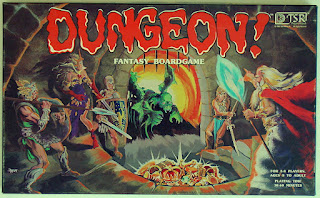
Mid 80's box cover of DUNGEON!

In the early and mid 1970’s David R. Megarry, a member of the same gaming group as Dave Arneson and David Wesley (of Braunstein fame) and player in Arneson’s 1972 Blackmoor campaign, began to play around with the concepts he learned dungeon crawling in Blackmoor to create his own game: “Dungeons of Pasha Cada”. He sent initial handmade copies were to friends and attempted to publish through Parker Brothers but was rejected. Eventually, as part of the absorption of the Minneapolis-St. Paul gaming group, Megarry joined TSR and his game was published as DUNGEON!, with Gygax, Steve Winter, and others were added to the game's authors' list.

Built from memories of Blackmoor and the Chainmail Fantasy Supplement for monsters, spells, and concept, DUNGEON!’s rules are a brew of mid-century war games rules that may ultimately lead back to the dawn of American war gaming - Charles A. L. Totten’s Strategos (1880). While DUNGEON! is first and most importantly a board game, in the context of playing old fantasy RPGs, DUNGEON! represents an alternate evolution of Blackmoor, Greyhawk and Dungeons & Dragons.

DUNGEON! was published by TSR, only tangentially part of the Dungeons & Dragons by implication, where it remains (Wizard’s of the Coast last published a version in 2014) somewhat unchanged from the early editions. DUNGEON!'s monster and adventurer selection is firmly set in the implied setting of early Dungeons & Dragons and its name and aesthetics are so similar to early Dungeons & Dragons that in the 1980’s it was often presented as or assumed to be (at least by the folks I knew) some sort of introduction to the game for the uninitiated (its rules with their add for Dragon Magazine imply this as well). DUNGEON! though is a very, very different game from Dungeons & Dragons, both in its mechanics and goals. DUNGEON! has interesting design, intentional design even, with effort put into making a fast, competitive board game that includes RPG elements such as character asymmetry and advancement.

DUNGEON! IS INTENTIONAL DESIGN
Dungeon isn’t a roleplaying game, it’s not a version of Dungeons & Dragons, or even Blackmoor - notably it doesn’t have a referee or dungeon master, it offers no open ended obstacles based on description or faction intrigue. DUNGEON! doesn’t even resemble contemporary refereeless games as it has no elements of shared narrative control or storytelling. It is just a board game, where control of setting and “story” are lodged firmly with the designer and the random determinations of the dice - the players of course have some agency in that they decide where their adventurers go and what routes they take, but it doesn’t offer control in the way that contemporary referee free RPGs like Fiasco do. While DUNGEON! isn’t a roleplaying game in the normal sense, it still contains some of the basics of dungeon exploration: navigation as a puzzle, risk and reward calculations and turnkeeping.

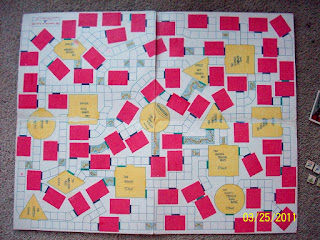
The Original Board for DUNGEON!
Superficially DUNGEON! looks a lot like classic Dungeons & Dragons. Its cards depict monsters and treasure in the same sort of scratchy black and white art as D&D's original booklets, the map is an underground maze (with 92 rooms!), and the names and titles of the various monsters and adventurers are the same. In DUNGEON! each player takes the role of an adventurer an elf, hero, superhero or wizard who plunges into the dungeon in search of treasure. The rest of the mechanics are very different though, and intentionally so. Unlike RPGs these adventurers are in competition, not a party that works together. Each adventurer wins when they return to the center of the map (the Main Staircase) with treasures worth a specific amount, more for the more powerful adventurers. Each adventurer can move 5 squares (rooms or the yellow blocks breaking up corridors) and each colored “room” contains a set of cards - a “monster” to fight and the “treasure” it guards.

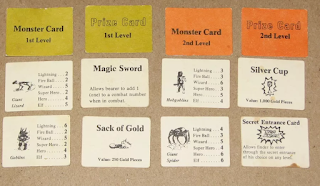
Combat consists of rolling 2d6 aiming for a target number based on adventurer class and the monster. A second roll determines the result of a lost combat, with only a 2 resulting in the “death” of the adventurer, and 3 or 12 resulting in a serious injury, loss of all treasure, and retreat back to the stairs. That’s around an 11% chance of serious loss (most negative results end in retreat, loss of a turn or single treasure) assuming a failed first roll. Once a monster is defeated the adventurer collects the treasure or possibly a magic item that will improve their future chances by looking at cards in other rooms (crystal balls, esp medallions) or adding to their attack roll (magic swords). Wizards alone can cast spells, mostly to attack monsters without risk of reprisal. Advanced rules exist allowing players to ambush each other. 

Low Level Monsters and Treasure

These simple rules are meant to create a high risk competitive board game, they don't support character development or cooperation, and they don't present open ended problems beyond player strategy in navigating the board and judging risk. Looking at them closely, or playing DUNGEON!, it's clear how well the rules manage to deliver on this simple concept and how complex player decisions can become.

Monday, November 1, 2021

Classic Vs. Treasure, Part 1

All Illustrations are
Howard Pyle's from 1883 - 1921

TREASURE TROUBLE
One aspect of Dungeon Crawl play that All Dead Generations hasn’t covered in any detail is treasure. This is an oversight, because treasure, like exploration, like encounters, and like combat is an important element of fantasy RPGs and especially important to the older style of play that All Dead Generations discusses. When we consider how treasure works in fantasy RPGs it usually seems fairly simple, even in Classic games - pick up the treasure and bring it back to civilization for experience and leveling. It is this simple, this is the gist of treasure in Classic fantasy RPGs -- pure reward ... but like everything else in the interconnected edifice of Classic play treasure presents its own complexities that interact with various important procedures and mechanics. Unfortunately the way treasure is structured in most classic systems makes it less of a reward and more of a chore, eating up play time with logistics and calculation.

The Function of Treasure
First, recovered treasure is the Classic player’s metric of success. Even in Classic rule sets that provide experience for defeating or killing monsters (something I dislike as it sends confusing messages about the goals of exploration), the majority of characters’ experience will come from the treasure recovered in the dungeon. Random treasure generation has been a mainstay of Referee preparation since the first edition of Dungeons & Dragons however, and it has an enduring appeal because imagining treasure is delightful - it’s a space where wonder can enter RPGs, this alone makes it valuable. Yet, these formative random treasure systems, as found in all early Dungeons & Dragons, reject wonder. Despite the gambling style fun of rolling up random hoards, random treasure has been largely unvariegated mass of coinage.

There are mechanical reasons for these coin hoards, coins are far easier to generate randomly and far easier to track encumbrance for. Dungeons & Dragons has also long used coin based encumbrance, with characters able to carry a few thousand coin weight (it varies by edition and represents a failure point for early dungeon crawl mechanics - see below). This ease couples well with the gambling appeal of random treasure generation, and the random “treasure types” that appeared in the 1970’s white box have endured appeal, despite most older editions cautioning against coin hoards for various reasons. However, even when a designer or referee doesn’t use random generation or design advice cautions against it the treasure tables set the standard and expectation of what treasure looks like in Dungeons & Dragons, and from there fantasy adventure as a genre.

More influentially random treasure generation in early editions of Dungeons & Dragons provide guidance about the expected speed of character advancement. For example, if the party defeats a dragon in 1981 Basic D&D and takes its hoard they will find the glorious Treasure Type H, worth an average of 50,000 GP. This of course isn’t really a linear challenge system as even the relatively weak six Hit Die White Dragon has such a hoard, while the much more dangerous saber tooth tiger (big cats are absolute terror beasts in Basic) they will get only a few hundred gold from its paltry Treasure Type V (or more likely nothing - the chances of having even d100 GP is 10%). Still, Treasure Types and random coin hoards are the main way that early editions offer referees and home designers a means of visualizing the rewards of successful adventuring and so provides clear metrics for pacing and level advancement.

Yet, treasure should be more than coins. Coins are a simple game currency that characters can exchange on a 1 of 1 basis for experience points, but “treasure” is, like fantastic locations and strange creatures, a concept that offers up the excitement of fantasy. Yet I won’t suggest abandoning random treasure generation in favor of inventing unique treasure caches as part of adventure preparation, perhaps lovingly describing each valuable object after reviewing the online collection of the British Museum for inspiration. This is time consuming fun, but it neglects an important element that makes coin hoards useful -- coin hoards work perfectly with early Dungeons & Dragons coin based encumbrance system to create complications and allow players to make informed judgments about the relative value of specific treasures.

The coin system is still of course dull, but it need not be as it’s easy to expand and cover a wider variety of treasure with minimal change, once one recognizes its mechanical basis and if one is willing to set aside some of the implied setting it creates.

Wednesday, October 6, 2021

A STRUCTURE FOR CLASSIC EXPLORATION PROCEDURE


The Procedural 

Dungeon  Crawl

The “Procedural Dungeon Crawl” gets mentioned a lot on All Dead Generations” and many of the pieces here describe its theoretical underpinnings -- but what exactly is the Procedure in the Procedural Dungeon Crawl? Not “What is Procedure?” in some abstracted way, but specifically, what Procedure does one follow to produce a Turn of Classic Exploration play?

Below are two lists that breakdown how I would run a Turn of Exploration in both a Classical way (using OSE similar clones or 1981 Moldvay Basic [B/X] mechanics) and how I actually run my own games (using house ruled 1974 Dungeons and Dragons.) Both function just fine with the other rule set however (some movement distances are different, and by the book OD&D adds procedures for incidental traps that I omit because not every square foot of every dungeon has broken pit traps in it) as they are Procedure rather than mechanics.

Before I go into detail about how and why they work, here are the “Classical” and my own “Neo-Classical” (with plentiful ideas from other bloggers and designers) methods of running an Exploration Turn as I understand them:

CLASSICAL EXPLORATION PROCEDURE

TURN BEGINS
A. Referee calculates and Players note equipment and/or status changes due to passage of a 10 minutes.
B. Random Encounter Die Events are resolved. (Can Open Encounter Procedure).
C. Referee describes surroundings (Can open Encounter or Combat Procedure).
D. Players ask questions about surroundings or events and the Referee clarifies.
E. Players state actions.
F. Referee confirms player actions with clarification of any mechanics used.
G. Actions are resolved. Any movement is calculated.
H. Players note any status or equipment changes on Character Sheets.
I. Roll Random Encounter Die for next Turn.
TURN ENDS


NEO-CLASSICAL EXPLORATION PROCEDURE

TURN BEGINS
AA Referee describes surroundings (Can open Encounter or Combat Procedure) and applies Exploration Die results from the prior Turn.
BB. Exploration Die Events are resolved and noted. (Can Open Encounter Procedure)
CC. Players ask questions about surroundings or events and the Referee clarifies.
DD. Players state actions.
EE. Referee confirms player actions with clarification of any mechanics used.
FF. Actions are resolved.
GG. Players note any status or equipment changes on Character Sheets.
HH. Roll Exploration Die for next Turn.
TURN ENDS

Old Games

Let’s talk about old tabletop roleplaying games - specifically the kind of games played in the 1980’s and recently depicted in the nostalgia...