Showing posts with label Review. Show all posts

Wednesday, January 12, 2022

DUNGEON! & Dungeons

THE BOARD GAME - DUNGEON!
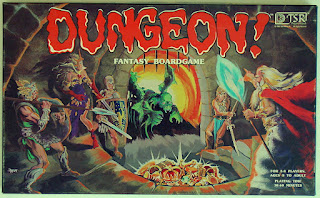
Mid 80's box cover of DUNGEON!

In the early and mid 1970’s David R. Megarry, a member of the same gaming group as Dave Arneson and David Wesley (of Braunstein fame) and player in Arneson’s 1972 Blackmoor campaign, began to play around with the concepts he learned dungeon crawling in Blackmoor to create his own game: “Dungeons of Pasha Cada”. He sent initial handmade copies were to friends and attempted to publish through Parker Brothers but was rejected. Eventually, as part of the absorption of the Minneapolis-St. Paul gaming group, Megarry joined TSR and his game was published as DUNGEON!, with Gygax, Steve Winter, and others were added to the game's authors' list.

Built from memories of Blackmoor and the Chainmail Fantasy Supplement for monsters, spells, and concept, DUNGEON!’s rules are a brew of mid-century war games rules that may ultimately lead back to the dawn of American war gaming - Charles A. L. Totten’s Strategos (1880). While DUNGEON! is first and most importantly a board game, in the context of playing old fantasy RPGs, DUNGEON! represents an alternate evolution of Blackmoor, Greyhawk and Dungeons & Dragons.

DUNGEON! was published by TSR, only tangentially part of the Dungeons & Dragons by implication, where it remains (Wizard’s of the Coast last published a version in 2014) somewhat unchanged from the early editions. DUNGEON!'s monster and adventurer selection is firmly set in the implied setting of early Dungeons & Dragons and its name and aesthetics are so similar to early Dungeons & Dragons that in the 1980’s it was often presented as or assumed to be (at least by the folks I knew) some sort of introduction to the game for the uninitiated (its rules with their add for Dragon Magazine imply this as well). DUNGEON! though is a very, very different game from Dungeons & Dragons, both in its mechanics and goals. DUNGEON! has interesting design, intentional design even, with effort put into making a fast, competitive board game that includes RPG elements such as character asymmetry and advancement.

DUNGEON! IS INTENTIONAL DESIGN
Dungeon isn’t a roleplaying game, it’s not a version of Dungeons & Dragons, or even Blackmoor - notably it doesn’t have a referee or dungeon master, it offers no open ended obstacles based on description or faction intrigue. DUNGEON! doesn’t even resemble contemporary refereeless games as it has no elements of shared narrative control or storytelling. It is just a board game, where control of setting and “story” are lodged firmly with the designer and the random determinations of the dice - the players of course have some agency in that they decide where their adventurers go and what routes they take, but it doesn’t offer control in the way that contemporary referee free RPGs like Fiasco do. While DUNGEON! isn’t a roleplaying game in the normal sense, it still contains some of the basics of dungeon exploration: navigation as a puzzle, risk and reward calculations and turnkeeping.
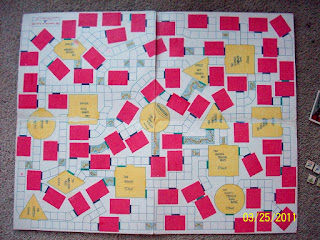
The Original Board for DUNGEON!
Superficially DUNGEON! looks a lot like classic Dungeons & Dragons. Its cards depict monsters and treasure in the same sort of scratchy black and white art as D&D's original booklets, the map is an underground maze (with 92 rooms!), and the names and titles of the various monsters and adventurers are the same. In DUNGEON! each player takes the role of an adventurer an elf, hero, superhero or wizard who plunges into the dungeon in search of treasure. The rest of the mechanics are very different though, and intentionally so. Unlike RPGs these adventurers are in competition, not a party that works together. Each adventurer wins when they return to the center of the map (the Main Staircase) with treasures worth a specific amount, more for the more powerful adventurers. Each adventurer can move 5 squares (rooms or the yellow blocks breaking up corridors) and each colored “room” contains a set of cards - a “monster” to fight and the “treasure” it guards.

Combat consists of rolling 2d6 aiming for a target number based on adventurer class and the monster. A second roll determines the result of a lost combat, with only a 2 resulting in the “death” of the adventurer, and 3 or 12 resulting in a serious injury, loss of all treasure, and retreat back to the stairs. That’s around an 11% chance of serious loss (most negative results end in retreat, loss of a turn or single treasure) assuming a failed first roll. Once a monster is defeated the adventurer collects the treasure or possibly a magic item that will improve their future chances by looking at cards in other rooms (crystal balls, esp medallions) or adding to their attack roll (magic swords). Wizards alone can cast spells, mostly to attack monsters without risk of reprisal. Advanced rules exist allowing players to ambush each other. 
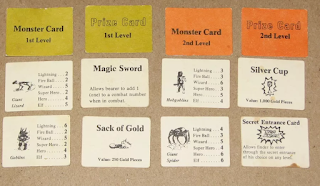
Low Level Monsters and Treasure

These simple rules are meant to create a high risk competitive board game, they don't support character development or cooperation, and they don't present open ended problems beyond player strategy in navigating the board and judging risk. Looking at them closely, or playing DUNGEON!, it's clear how well the rules manage to deliver on this simple concept and how complex player decisions can become.

Tuesday, May 12, 2020

Dragon of Icespire Peak - A Review


A REGRETTABLE WASTE OF OPPORTUNITIES


Icespire GM's Screen - that almost makes up for sparse art.

This blog isn't often kind to the products of Wizards of the Coast - largely because the ‘Crawl’ (as in Dungeon Crawl) playstyle that All Dead Generations champions is very different then the one 5th edition Dungeons & Dragons seems directed towards. Yet, taking a deep look at offerings from Wizards of the Coast is one of the best ways to highlight those differences and understand them. Lost Mines of Phandelver has been the WotC sanctioned introductory adventure since the 5th edition came out, but in 2019 Wizards of the Coast published the Essentials Kit, updating the boxed set concept for 5th edition and including an introductory adventure/campaign “Dragon of Icespire Peak”.

Introductory Adventures

Introductory adventures are interesting things, doing a lot of work to define setting, and if they're part of a particularly successful system they can offer a model for adventure design to an entire generation of players. When the first edition of Basic Dungeons and Dragons was introduced in 1977 it didn’t contain an adventure, though this was remedied by 1978, when B1 (for “Basic”) “In Search of the Unknown” by Mike Carr was included. In Search of the Unknown, despite an alluring cover illustration* and amazing title has to be regarded as a somewhat experimental product, which perhaps took its role of educating the new GM too far at the cost of being fairly uninteresting and a bit unplayable. Alternatively B1 represents an insight into what early D&D looked like -- its lack of naturalism or any kind of monster ecology (it depends on random stocking) and equally unnatural map emblematic of a wargame derived early play that Gygax (for all his flaws) showed an alternative to. B1 was quickly supplemented by B2 “Keep on the Borderlands” by Gary Gygax, which is likely his best work, and still remains a read for anyone interested in adventure design or game mastering.

“Keep on the Borderlands”, the nature of the challenges in its caves of chaos and the playstyle it fairly effectively taught defined Dungeons & Dragons for TSR’s early 80’s golden age: dungeon crawls based on a stilted internal logic and ecology where scheming humanoid factions were the primary foes within a ‘points of light’ setting. That’s the power of the introductory adventure, to not only showcase an official setting (promoted or implied), but to set the tone and playstyle. “Keep on the Borderlands” was removed from D&D basic sets in 1983, which instead included a short solo adventure heavy on scripted events (as it would have to be given it’s solo nature), around the same time as the first Dragonlance module (“Dragons of Despair”) was published championing adventures of the linear, scene-based style where player characters receive immunity from harm to assure the adventure's narrative remains predictable.

Yet “Keep on the Borderland” set the basic model for the introductory adventure, one that “Dragon of Icespire Peak” even follows to some degree, it to is a regional set of adventures set in a lawless region of a world where “[e]ven farms and freeholds within a day's walk of a city can fall prey to monsters” prefaced by more general play instructions and including play aides. The adventures within “Dragon of Icespire Peak” however, and especially how they are structured, vary from the open world presentation of B2. The question for this review is thus “How well does Dragon of Icespire Peak work to introduce players and GMs to the game, and what sort of game does it introduce?” Even more specifically, and derived from looking at other 5th Edition products, “What, if any, are the contradictions between Dragon of Icespire Peak’s fiction (setting and adventure details) and the mechanical playstyle it presents?”

Dragon of Icespire Peak


A 64 (Including 15 pages of 5th editions’ indulgent monster stat blocks) page series of 13 adventure locations ranging in size from 5 (Umbrage Hill - a Manticore attack) to 30 (Axeholm - A ruined Dwarven Fortress) keyed locations and designed to be played episodically, connected by an underlying structure of regional events. I believe the adventure is written by Chris Perkins, he’s credited as the designer in the rulebook, but not the adventure itself. Likewise art in the standard 5th edition style drawn by a passel of artists specifically for the adventure, unlike early 5th edition offerings. The art and cartography has the bright colors and generic fantasy look one expects from a Wizard’s of the Coast product, though it’s pretty sparse - we have illustrations of several monsters, cover art of some adventurers confronting the titular dragon, NPC illustrations, a vista of Phalanden, a random gnome fiddling with a contraption and a skeletal horse. Given the blandness of the wotC house imagination/style and the quotidian content of Dragon of Icespire Peak this is good as far as it goes. No illustrations that are especially useful at the table (magic items, complex rooms), but the NPC cards are a nice touch and drawn in a more whimsical style than most WotC illustrations. Maps are likewise typical of a WotC product, serviceable, not especially complex but not entirely linear either -- though the small number of keyed areas in many of the locations limit the orienteering aspect, which is perhaps a hallmark of 5th edition play.

Reading through the overall introduction of “Dragon of Icespire Peak”, I’m pleasantly surprised by its openness and stated commitment to player choice. The central “job board” gimmick is something borrowed from CRPGs from before they had the budget or graphics to animate NPCs - but I guess it’s an expected trope. I sometimes wish there was a board in my town that said things like “The mayor will pay $5,000.00 to any brave souls that investigate the ruined missile silos and defeat the scabrous vermin that dwells within” but like much of WotC’s brand of D&D fantasy the job board has a logic of its own at this point. Starting quests lead to complications and new quests that all tie into an overarching region's situation of the same sort that this blog champions - factions fighting over land and power, with the adventurers theoretically holding the balance. While Dragon of Icespire Peak still assumes the party and players will be drawn to heroic motives, unlike many WotC offerings it doesn’t lay out how to act on them in a linear and entirely predetermined manner. The seemingly open basic structure is reinforced by a set of advice that might seem familiar to All Dead Generations readers, though it's fairly general in nature.

Saturday, January 25, 2020

Descent into Avernus - Dungeon Keying

In the last post All Dead Generations looked at the general design principles in Wizard’s of the Coast’s new campaign tome Baldur’s Gate: Descent into Avernus, and compared them to the classic style of open world, location based dungeon crawls. Descent into Avernus is not a classic adventure, it is not meant to be played as an open world and even its locations which have some of the trappings of dungeons, or are named dungeons, aren’t in any mechanical sense. Rather the majority of Descent’s dungeons appear to either be small lairs, arenas to facilitate a specific encounter, or a series of linear scenes sometimes laid atop a map but largely unconnected during play.


The Dungeon of the Dead Three is the last of these: a selection of encounters partitioned off from the location largely as a means of introducing or ending them each with filmic or novelistic flair - to create a predesigned “moment” of gameplay. This is obviously a very different play style then the classic dungeon crawl, and it seeks to produce predictable narrative moments at every opportunity - willingly sacrificing many aspects that define the classic dungeon crawl to do so. Still, The Dungeon of the Dead Three and Descent into Avernus in general show care and creativity, and the contents of the individual keyed areas within it can be evocative enough that even a reader who doesn’t like the encounter based playstyle must recognize that Descent’s design choices are intentional.

The Dungeon of the Dead Three in particular deserves a closer look, because of anything within Descent it is most like a classic dungeon crawl, and seems to want to evoke the feeling of one - even if it pays no attention to the exploration elements of timekeeping, supply or risk management. Yet, despite disfavoring an exploration playstyle (which is hard not to with the 5th Edition of Dungeons & Dragons mechanics) Dungeon of the Dead Three includes many aspects that superficially make it appear to be a classic dungeon: a looping map that includes empty or nonessential rooms, traps and secret doors as well as a traditional feeling of the dungeon crawl - the infiltration or exploration of close corridors in an alien underworld. Here of course that’s focused on a sewer, which unfortunately is also a popular video game cliche, but at least it avoids including wererats. Because of these inclusions, it’s easier to conceive of the The Dungeon of the Dead Three as a classic dungeon, and despite its designers clear intent for it to play very differently, one can interrogate it in the context of running a resources, risk v. reward dungeon crawl.

Beyond modifying or including rules that better encourage exploration play (e.g. random encounters, timekeeping, meaningful encumbrance, and lighting) the question of “how does one design a dungeon that facilitates exploration play” remains. With the larger elements of the adventure: map, concept and basic structure in place, or at least not actively working against the dungeon crawl play-style, the core of the design process is in the individual location keys.

Keys are the basic building block of adventure design, information that the designer believes most important to understanding the location, provided in a way to allow the reader to run the adventure.

TEXTUAL PITFALLS
There's a variety of techniques to keying locations, from the ultra minimalism found in some of the first published adventures, to boxed text designed originally for tournament adventures, and bullet points or other, mixed types of formalism. The style used in Descent is mixed one: short boxed text, sometimes preceded by and always followed by GM directed text about room contents. Areas without encounters (combat in Descent) lack boxed text and have only short paragraphs. The writing itself is serviceable, but it doesn’t appear to have been intended as writing for a location based adventure, and it’s not well focused on usability. The organization that exists is a haphazard use of bolding to set off paragraphs about treasure or traps in some of the locations. This sort of effort is good, but without consistency it doesn’t help a GM run the location by highlighting the most important information in the key so that it stands out. Descent does make laudable effort to limit the length of its locations, but because of uninspired writing may do so at the cost of dulling down the play experience of the dungeon as a whole.

Boxed text is always a concern, it exists to regularize play experience, an understandable goal in the tournament modules that pioneered it, but unnecessary for players and GMs that aren’t in a tournament. Like all design choices, it has a cost as well as an advantage and that cost is generally a risk of confusion for both players and GM. There’s a lot of potential sins for a designer writing boxed text (or simple keys without read aloud text), and below is a list of some of the most obvious with notes on how well Descent’s Dungeon of Dead Three manages them.

Wednesday, December 11, 2019

Descent into Avernus - From a Dungeon Crawl Perspective

Cover of Descent Into Avernus
With the basic ideas behind dungeon crawl style play covered, I'll be taking a look at the current state of contemporary Dungeons & Dragons adventure design and how it succeeds or fails to deliver a Dungeon Crawl or Classic Play experience.  Specifically I'll be looking at the recently published Wizards of the Coast ("WotC") campaign book "Baldur's Gate: Descent into Avernus" ("Descent"). My goal isn't to attack or denigrate Descent or the play style it supports, but to discuss where and how it follows design principles that support classic play, where it departs from them and to what effect.  I may also be able to offer some ideas that will help others run the adventure in a more classic way emphasizing: dungeon crawling, player choice, and open worldbuilding.

Fairly typical of WotC's contemporary adventures Descent is a 200 plus page series of adventures that make up a campaign that will take characters from 1st to approximately 14th level.  It's designed for many sessions of play and an epic scope. The campaign is the product of a large team of authors, designers and artists including D&D's current creative leads Mike Mearls and Chris Perkins. It's also nice to see that much of the cartography within is the work of Dyson Logos, a blogger and map maker who I consider to be broadly part of the same community as All Dead Generations and whose distinctive cross hatching style is inspired by classic map design.

FIRST THE STORY
Descent is an epic story, and this is it's first goal, and the first way it departs from classic sensibilities.  Organized (as are the vast majority of contemporary WotC adventures) into Chapters Descent is a linear narrative where the players follow and unfolding danger, overcoming challenges and gaining power as they go. It's writers don't countenance players deviating significantly from the chapters, their order and the consequences or events of each.

Old Games

Let’s talk about old tabletop roleplaying games - specifically the kind of games played in the 1980’s and recently depicted in the nostalgia...