
FOR DUNGEON 23
With my decision to work on Dungeon23 coincides my starting a public Crystal Frontier Campaign and being dissatisfied with the progress I've been making to various new projects. I've got three large, rather experimental dungeons about 1/4 - 1/2 finished (including art and layout), and a smaller one of about 20 rooms 2/3 done, but they've just refused to come together this year. Hopefully at least the small one will be out sometime. So I've had lots of reasons to thinking a bit about how I personally design dungeons and adventures again - not as a theoretical exercise, but because I need to write some new, satisfying dungeons.
Below are some notes on my personal quick technique for getting something together for play at my table and (after a lot of additional polishing) for publication. I hope they can be of help to newer designers thinking about giving Dungeon23 a try (or really just writing up a dungeon to crawl). As always they are for the classic dungeon crawl style of play: exploration supported by procedural turnkeeping, supply, and randomized risk. They are likely the entirely wrong way to write an adventure that will make really good live action Youtube or help you run a Vampire the Masquerade campaign, I don't pretend to know how to do either of those things.
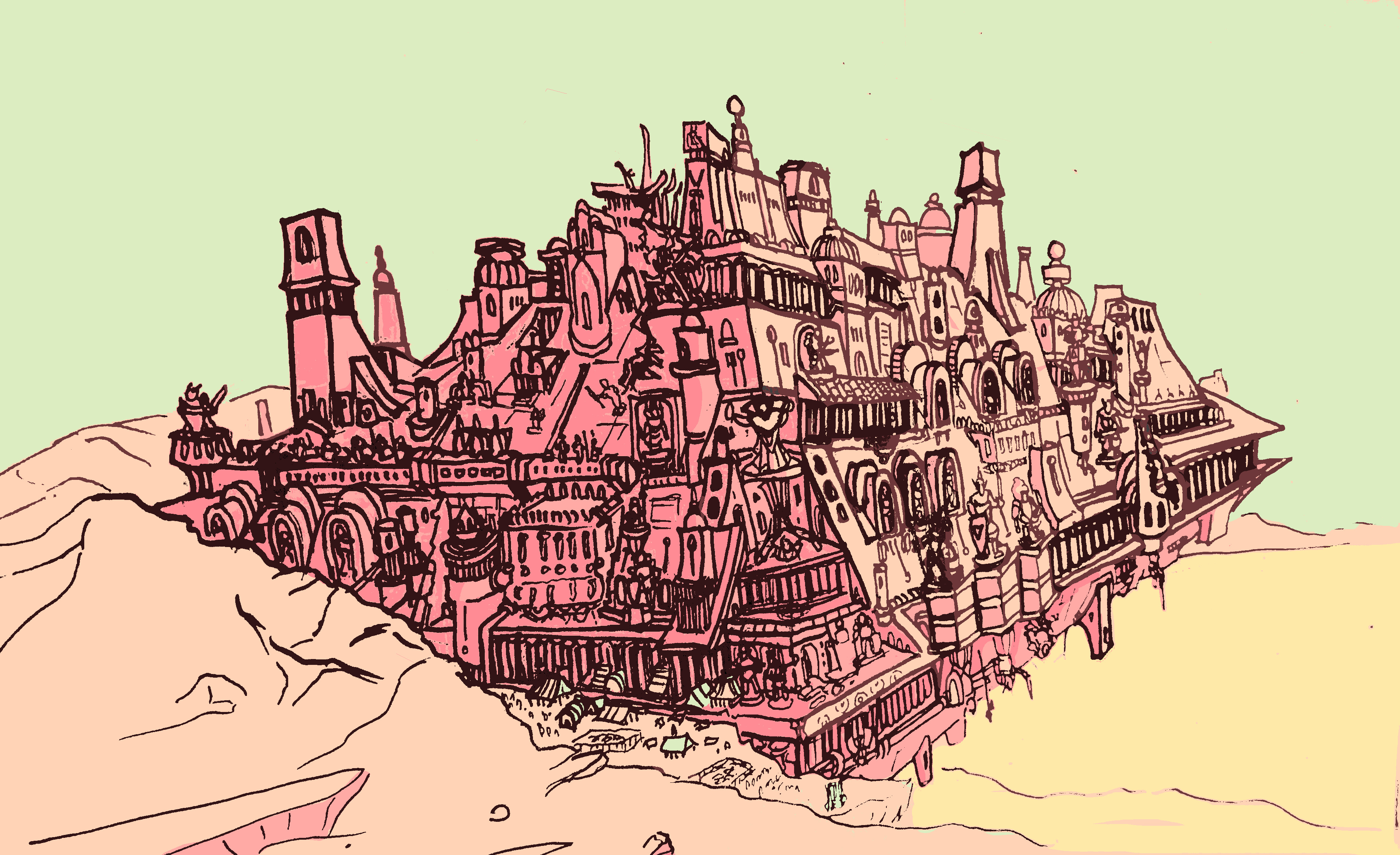
I’m a naturalistic, or maybe even ‘organic’ designer.
This has nothing to do with whole grains. As a style of adventure design, what I’m calling organic is an expansion of what's often described as “Gygaxian Naturalism” because Gygax discusses it in “The Campaign” section on pages 86-88 of the 1st edition Dungeon Master’s Guide. While the focus is usually on Gygax's creation of a fantasy ecology, I'd say he goes further and offers an approach to making dungeon adventures that form a logical whole.
It’s also obvious to me that this was Gygax’s personal style of adventure design, meaning naturalistic design was extremely important to the success of Dungeons & Dragons and roleplaying games more generally. Organic design shows through clearly in Gygax’s best work, his most memorable adventures such as Keep on the Borderlands (B2) and Against the Giants (G series). While these adventures might not appeal to everyone today, in praising them it’s important to look at them compared to other design options at the start of the hobby. Arneson’s original Temple of the Frog as included in the Blackmoor supplement for OD&D and Wee Warrior’s Palace of the Vampire Queen by the Kerestans are great counter examples.
The naturalism and coherence of Gygax’s adventures sets them apart, he focused on the dungeon space as interconnected by logical relationships, sometime ecological, but often political or historical. His contemporaries produced dungeons that were far closer to a board game sytle series of encounters, or as the afterthought to a larger scale political and military conflict (which Arneson did design quite naturalistically). The mead hall of Gygax’s giant chief makes sense as a location, structurally, thematically, and as an adventure. Its rooms have clear uses and a sensible layout within the larger fictional space. Its inhabitants relate to each other and have uses for the spaces they inhabit. While Gygax's dungeons are far from realistic, and can become odd at times there’s almost always a thruline of sense and purpose that can only come from the conscious effort to build a dungeon around its inhabitants and a theme. As affirmed in his Dungeon Master’s Guide, Gygax doesn’t want to overthink the logic of his dungeons as a simulation, but to create a plan and structure a location that are comprehensible to and and exploitable by the players. You can poison the giant’s stew in the Steading of the Hill Giant Chief because the kitchen and feast hall exist as part of a sensible and coherent whole—that’s Gygaxian Naturalism (though the term is also used sometimes to describe a group writing process). Jennell Jaquays, tentatively with F'Chelrak's Tomb (1976), and notably in her later adventures Caverns of Thracia and Dark Tower (less effectively), expands on Gygaxian Naturalism quite successfully. Her designs start the practice of layering history and increasing the density of description, the level of interactivity, significance of faction relationships, and spacial complexity of dungeons making them more functional for exploration.
In some circles, Gygax’s other major contribution to adventure design is more popular - procedural generation. Appendices A-H of the Dungeon Master Guide are one of the first (they date back to Strategic Review/Dragon, Issue 1 as a way to play D&D solo) efforts to define this technique - providing a means for a dungeon to build itself through random dice rolls.
I’m not much of a fan. Here’s why.
I’ll acknowledge that procedural generation can be useful as a springboard for ideas or to fill space in a hurry when nothing better is available (such as when your players move off “the map”), but randomly generated rooms are either too vague and disconnected for anything more than board game style play, or require such complex tables that the designer might as well just produce a much larger keyed adventure with the amount of space and ideas. Relying on random stocking almost always means that the details and complexity need to be filled in, and the random design expanded and rationalized. You’ll still end up describing, keying, factionalizing and connecting the parts of your dungeon for it to function well. All procedural generation does is add the step of randomly generating elements of the space that have to be revised to give the dungeon coherence.
These are the basics of what sort of dungeons I want to write. Classic keyed spaces with a high degree of coherence, interactivity, variety, a layered history (useful and discovered via clues in play), navigational puzzles, and both description and themes that go beyond those of typical Gygaxian vernacular fantasy or the contemporary expectations of standard fantasy settings.


