
 |
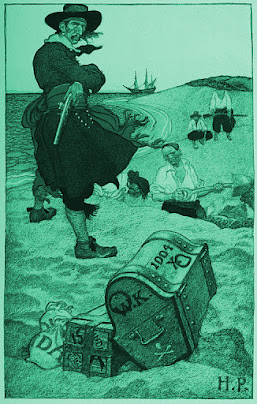
| All Illustrations are Howard Pyle's from 1883 - 1921 |
One aspect of Dungeon Crawl play that All Dead Generations hasn’t covered in any detail is treasure. This is an oversight, because treasure, like exploration, like encounters, and like combat is an important element of fantasy RPGs and especially important to the older style of play that All Dead Generations discusses. When we consider how treasure works in fantasy RPGs it usually seems fairly simple, even in Classic games - pick up the treasure and bring it back to civilization for experience and leveling. It is this simple, this is the gist of treasure in Classic fantasy RPGs -- pure reward ... but like everything else in the interconnected edifice of Classic play treasure presents its own complexities that interact with various important procedures and mechanics. Unfortunately the way treasure is structured in most classic systems makes it less of a reward and more of a chore, eating up play time with logistics and calculation.
The Function of Treasure
First, recovered treasure is the Classic player’s metric of success. Even in Classic rule sets that provide experience for defeating or killing monsters (something I dislike as it sends confusing messages about the goals of exploration), the majority of characters’ experience will come from the treasure recovered in the dungeon. Random treasure generation has been a mainstay of Referee preparation since the first edition of Dungeons & Dragons however, and it has an enduring appeal because imagining treasure is delightful - it’s a space where wonder can enter RPGs, this alone makes it valuable. Yet, these formative random treasure systems, as found in all early Dungeons & Dragons, reject wonder. Despite the gambling style fun of rolling up random hoards, random treasure has been largely unvariegated mass of coinage.
There are mechanical reasons for these coin hoards, coins are far easier to generate randomly and far easier to track encumbrance for. Dungeons & Dragons has also long used coin based encumbrance, with characters able to carry a few thousand coin weight (it varies by edition and represents a failure point for early dungeon crawl mechanics - see below). This ease couples well with the gambling appeal of random treasure generation, and the random “treasure types” that appeared in the 1970’s white box have endured appeal, despite most older editions cautioning against coin hoards for various reasons. However, even when a designer or referee doesn’t use random generation or design advice cautions against it the treasure tables set the standard and expectation of what treasure looks like in Dungeons & Dragons, and from there fantasy adventure as a genre.
More influentially random treasure generation in early editions of Dungeons & Dragons provide guidance about the expected speed of character advancement. For example, if the party defeats a dragon in 1981 Basic D&D and takes its hoard they will find the glorious Treasure Type H, worth an average of 50,000 GP. This of course isn’t really a linear challenge system as even the relatively weak six Hit Die White Dragon has such a hoard, while the much more dangerous saber tooth tiger (big cats are absolute terror beasts in Basic) they will get only a few hundred gold from its paltry Treasure Type V (or more likely nothing - the chances of having even d100 GP is 10%). Still, Treasure Types and random coin hoards are the main way that early editions offer referees and home designers a means of visualizing the rewards of successful adventuring and so provides clear metrics for pacing and level advancement.
Yet, treasure should be more than coins. Coins are a simple game currency that characters can exchange on a 1 of 1 basis for experience points, but “treasure” is, like fantastic locations and strange creatures, a concept that offers up the excitement of fantasy. Yet I won’t suggest abandoning random treasure generation in favor of inventing unique treasure caches as part of adventure preparation, perhaps lovingly describing each valuable object after reviewing the online collection of the British Museum for inspiration. This is time consuming fun, but it neglects an important element that makes coin hoards useful -- coin hoards work perfectly with early Dungeons & Dragons coin based encumbrance system to create complications and allow players to make informed judgments about the relative value of specific treasures.
The coin system is still of course dull, but it need not be as it’s easy to expand and cover a wider variety of treasure with minimal change, once one recognizes its mechanical basis and if one is willing to set aside some of the implied setting it creates.


