Showing posts with label Design Principles. Show all posts

Saturday, November 15, 2025

Dungeon Design Note: Obstacles Support Exploration

Less Combat ... More Obstacles

I’ve been talking about dungeon crawling as a play style here for years, and I’m not alone among RPG bloggers to do so. Most of the points All Dead Generations focuses on, such as the importance of turnkeeping, supply mechanics, random encounters, navigating dungeons, and threats to characters that don’t involve hp loss, are fairly well understood in the Post-OSR space or at least fairly well represented.


Yet… I don’t see a lot of focus on the play style itself … especially in the adventures released. Perhaps dungeon crawling just feels old and boring compared to the popular subjects of “high level play”, “wilderness crawling”, or “mass combat” … but rather then complain about what people like at the moment, I suspect something more is at work. Just as you can’t bake much of a cake you can’t run much of an exploration based dungeon crawl without a dungeon that supports exploration. 


As I’ve mentioned, writing good dungeons is hard, and this means too many dungeon based adventures, old and new, aren’t designed for dungeon crawling, instead they usually focus on combat encounters and sometimes complex puzzles … This won’t do it, not alone. Set piece combat and a complex room puzzle can’t make for a solid exploration adventure, because they so easily become a series of disconnected scenes. The core of Dungeon Crawling is players making informed choices about where to go in a location and “obstacles” to overcome to get there.


An obstacle is a relatively simple challenge that impedes further exploration or makes it risky in some other way. The obstacle can be something as simple as a locked door,because obstacles are smaller in scale, less complex, and less threatening then set piece puzzles or hidden traps. They aren’t intended to offer a serious threat or difficulty and likewise don’t protect significant treasure. Obstacles are a challenge that requires player intervention or resources to move past, but isn’t likely to create a permanent obstacle.


The function of obstacles is largely to root the adventure in the location and offer alternative challenges along the potential routes of exploration. For example … the party might head North in the dungeon and encounter a locked steel door. Not having one of the obvious tools to pass it (a thief with lockpicking skills or the knock spell) they have the options of retreat (returning next session with tools/spells), to search for a key, or to seek an alternate path through the dungeon that bypasses the door. 


The first of these options (full retreat) is costly and discouraged by the risks of random encounters, including that of restocking between sessions and the equipment or supplies expended to reach the obstacle.  Full retreat is of course undesirable, the reverse side of the long despised “15 minute adventuring day”. While this undesirable situation can happen when players fetishize caution but it is usually the result of problems in adventure design. If one’s players have decided to deal with risk by retreating after every encounter or to perfect thier approach to every puzzle and obstacle the best course as a referee is to increase the risk of delay and the cost of slow exploration … rival adventuring parties that sweep in and loot areas the party is “saving for latter”, rile up dungeon inhabitants or set traps for the party are an effective way of doing this.


In most cases a party will choose one of the other two options: to search for a solution to the obstacle or blaze an alternate route. This depends on the availability of either clues and suitable materials, or alternate routes, and makes obstacles an issue for designers even more then one for players.  A well designed adventure must provide these alternative and tools, rather then offer a single linear path or insufficient tools. To put it another way - when the party finds a locked steel door they should also find clues as to where the key for the door can be found and/or have passed other potential routes. 


Of course alternate routes will themselves lead to obstacles and tools may require over coming some challenge to obtain. Trying to bypass the locked door might mean taking another route past a guard post … or perhaps backtracking to one and obtaining a set of keys from the guards. Obstacles can have this interplay or remain independent, but collectively they make it useful for players to understand the dungeons layout and offer a variety of challenges that different parties may choose among to reach the same goals or locations within the adventure.

Saturday, March 1, 2025

AN INTRODUCTION TO DUNGEON CRAWLING

You want to run a “Dungeon Crawl” adventure Not just an adventure in a "dungeon", but a Dungeon Crawl - that distinct, classic mode of RPG play about exploring a fantastical space, obtaining its treasures, and unraveling its secrets ... while surviving its dangers. Notably, the first rule of Dungeon Crawls is that surviving dangers does not always mean destroying or even overcoming them.

Dungeon Crawls should emphasize the tense experience of exploring a wondrous and dangerous location. These adventures will be more enjoyable if the referee pays attention to and uses the full suite of exploration rules while omitting even traditional rules that limit them, such as “darkvision” or “infravision” as a natural ability for characters. I encourage you to play with turnkeeping, encumbrance, and random encounters so you can experience how these mechanics work together to make navigating the fictional space tense. To help, this essay offers advice and even some streamlined alternatives to some classic exploration mechanics.


However, beyond mere game mechanics, this style of RPG depends upon utilizing a set of procedures—rules about how, when, and in what order the characters can act—that should make navigating the unexplored depths meaningfully tense. In particular the classic version of Dungeon Crawling relies on three ideas, and their corresponding rules, without some version of which the adventure is likely to be a less enjoyable experience.

1) Turn Keeping: Turns are important! They are the foundation on which all other Dungeon Crawl procedures are built. Though the Exploration Turn or just “Turn” is commonly described as ‘about ten minutes of time within the game world,’ it’s best not to get hung up on exact measures of time. This is a game, and like many games it is organized by turns. One player goes, then the next—or in this case: the player group goes, then the environment reacts through the referee. Because of this it’s more useful to think of Exploration Turns as an abstract unit representing the amount of in-game time it takes to perform most useful actions: moving, examining a room, or interacting with some object. After the players act, the setting acts and takes its own ‘turn’ by depleting the party’s supplies and checking for a random encounter. Of course some useful actions may require multiple Turns, and that creates greater risk.

2) Limited Supplies: Attrition is one way a Dungeon resists being explored. Players are rewarded for learning a Dungeon’s secrets by being able to venture further while enduring less attrition. Hence encumbrance rules (either based on coin (CN) weight or a “slot” system) are an essential limitation on the player’s resources. Time spent in the dungeon expends resources, especially light, and players must retreat before being trapped in deadly darkness. Encumbrance and supplies also force players to make decisions about what treasure to take. 


3) Randomized Risk: Dungeons are filled with tricks, traps, foes, puzzles, and confusing passages. The safest way to deal with them is to slowly and cautiously move through the space checking everything with the infamous  10’ pole and other tools. This makes for a tedious evening of adventure gaming. Besides the depletion of light and other supplies, the counterweight to player caution is randomized risk. Random Encounters are rolled once per Turn or two, and threaten the party with a potentially hostile creature that offers no or very limited rewards for fighting because most or all character advancement comes through recovering treasure. Worse, Random Encounters will often be more powerful than the party, as it is not essential to fight them and they represent the manifestation of risk for players who push their luck too far.

Together these three design principles and their supporting mechanics create the tripod that holds up a Dungeon Crawl. Though some may seem silly in the abstract, without them exploration becomes far less exciting and tense.

Tuesday, November 5, 2024

GYGAX'S FORTRESS

Gary Gygax is probably the best known name in Role Playing Games -- still, nearly 15 years after his death. Considered Dungeons & Dragons’ co-inventor and principal author of most of its early material, “Uncle Gary” was also a tireless promoter of his game and of role playing games as a whole. For the hobby’s ½ century Gygax’s name has been synonymous with it, he shouldn’t need an introduction, but it's still worth taking a close look at his adventure design legacy. Specifically how Gygax designed his dungeon adventures.

Gygax was author of many of the best early adventures for Dungeons & Dragons including: Steading of the Hill Giant Chief, Vault of the Drow, Village of Hommlett, Expedition to the Barrier Peaks, Tomb of Horrors and of course Keep on the Borderlands, likely the most played Dungeons & Dragons adventure of all time. While some of his adventures, such as Expedition to the Barrier Peaks and Tomb of Horrors, were at least significantly the work of others (Kask and Lucien respectively), though Gygax undoubtedly had a hand in them as well. His output was prodigious and his foundational adventures are still well known today. I’d argue that adventure creation, rather than rules of mechanics, was Gygax’s greatest strength as a designer. With Arneson, Gygax wrote a system of adventure or dungeon design into the 1974 edition of Dungeons & Dragons, but he didn't follow it long, and certainly not in his published work, instead innovating and diverging from his own early advice to pioneer a new style of adventure design. Yes, his most important contribution to the hobby was likely organization and promotion - and the hobby of role playing games owes him a great amount of credit, perhaps even its existence for his efforts there - but Gygax’s adventure design still stand tall a half-century later, and it's full of useful lessons and techniques. 

Gygax Design
Like all good designers, especially early in the hobby, Gygax’s design has its own flavor and concerns. For Gygax adventure design is most often focused on the nature of the forces opposed to the players and potential environmental factors or conflict among these enemies that the players can exploit. He was first a wargamer, and his signature adventures are far more “sieges” or “infiltrations” then they are “explorations”, though this is not universal or absolute. Gygax’s adventure writing itself is marked by an relative indifference to map design, and the use of sparse keys that offer the minimum of environmental detail while focusing on the monsters encountered and their military strategies or behavior.

Gygax designed a variety of scenarios over his long career, but the central challenge in Gygax’s best known adventures, at least the ones where he’s clearly the sole designer (again, not Tomb of Horrors or Expedition to the Barrier Peaks) is one of military tactics or strategy. In a Gygax adventure the party will succeed if they can outwit, destroy, suborn, or bypass a hostile, organized force more powerful than them. Examples of these forces include the giants in the Against the Giants modules, the humanoid tribes in Keep on the Borderlands, or the mountain giant and his flunkies in the Forgotten Temple of Tharizdun. In all cases the party is unlikely to survive a direct confrontation with the forces against them, and instead needs to use schemes, things they discover about and within the dungeon, or subterfuge to overcome them. Often these solutions require that the party access the enemy base/dungeon without alerting its guards, and then conduct a campaign of theft, assassination, and sabotage within.

The siege or infiltration scenario is natural enough, it’s the sort of thing that naturally evolves from skirmish wargaming -- where one wants to justify both a small group of characters and provide their player(s) agency within the context of a larger military conflict. In 2002, during a Question & Answer session on ENworld’s bulletin boards Gygax rejected idea that Dungeons & Dragons had an exact analogue to military siege scenarios, stating that “no actual D&D game module I've ever seen has taken the base, sieges, to the 'commando' raid stage, either in infiltrating a fortress of for breaking out of one to wreak havoc on the besiegers lines.” However, Gygax liked the concept, and claimed to be writing an adventure based on the scenario of infiltrating a fortress during a siege … his rejection of the idea appears more one of exacting terminology than to the suitability of the design itself. Setting aside the context of a strictly military “commando raid”, it’s obvious that Gygax often wrote adventures centered on infiltration as a part of a violent conflict - ambushes, evasion, assassination, and sabotage. While there are elements of dungeon exploration involved, including entire adventures written using other design forms, the infiltration scenario is distinct, and Gygax perfected it, even creating special tools to run it more efficiently. 

When interrogating this style of design, the first thing to notice is that the primary source of tension in a Gygaxian Siege is not supply depletion or the pure risk of random encounters, but the larger risk of an alarm being raised. Once the fortress is alerted the adventure will change almost fundamentally as the enemy forces begin to actively patrol, reinforce each other and gather at choke points. A siege adventure is not usually a race against the steady depletion of character resources like the traditional dungeon crawl, but an effort to get as close to one’s goals before the alarm is raised and the enemy begins to hunt the party.

Sunday, January 14, 2024

The Underground Maze or Primordial Stack


Crawling Down From 1974
“Dungeon crawl” has entered the popular lexicon as a description of any sort of adventure in an underground or ruinous space. It’s a common way to describe video games and occasionally other forms of media such as a part of novels or movies. Of course it’s most common in Roleplaying games, because the concept comes from Dungeons & Dragons, specifically from the earliest iterations of the game  - 1974's Dungeons & Dragons boxed set. What is it exactly though?

The term derives from the redefinition of the word “dungeon” by Dungeons & Dragons. Prior to the RPG hobby’s explosive growth in the 1970’s and 1980's the term's popular meaning (itself not the original 14th century meaning) of an underground prison was almost the only one. One can offer theories as to why Gygax & Arneson chose to use the word dungeon in both the title of their game and as a descriptor for the primary arena of play*. Interestingly within the first 1974 edition of Dungeons & Dragons, while the word dungeon is used more often than other descriptors for the place where adventures occur, it is largely in reference to the name “Dungeons & Dragons” or the title “Dungeon Master” for the referee. When Gygax & Arneson are serious about discussing the concept of the fantasy space the characters explore they most often use “Underworld” and sometimes “Labyrinth” or “Maze”. Dungeon is the description that stuck, and the word’s meaning is now far more likely to be the one derived from Dungeons & Dragons.

In the context of role playing games for “Dungeon Crawl” is most helpful as a term if it means something beyond a light aesthetic gloss connotation a particular type of D&D-like fantasy (or an element “Gygaxian vernacular fantasy” aesthetic to be more precise): a place of grim stone corridors, screeching not-men to murder, and the occasional treasure chest that bites. This sort of view of the dungeon and dungeon crawl aren’t a problem, it certainly captures something, but it also tends to create a lot of dispute, because it’s a surface definition. A handful of aesthetic cliches, this idea of the dungeon crawl is however immediately and intuitively easy to grasp -- it becomes the first impression of what a RPG dungeon consists of. It’s not especially helpful though, because it says nothing about how the adventure will work with rules or what sort of play it aims for.

To make the concept meaningful, as always I want to look at dungeon crawling and dungeon design specifically from the perspective of how well an adventure encourages or supports “the procedural exploration of a fantastic space”. This is my definition of the “Dungeon Crawl”. It’s what is often referred to as a “location based” adventure, but I would add the additional qualification that a Dungeon Crawl also emphasizes exploration by connecting it to risk mechanics.

Likewise, this sort of design is sometimes considered the product of the early phases of the RPG hobby, especially of early Dungeons & Dragons. To some extent this is true, Dungeons & Dragons started to define this style of adventure design beginning in the 1974 edition, but I would argue that the game quickly grew away from it, with early D&D communities rapidly pushing the rules towards more character and scene-based scenarios such as wilderness adventure and narrative paths as early as the late 1970’s. The Dungeon Crawl was sidelined for some time, and its development has been fairly slow since, or largely about moving away from the granularity of room by room exploration and risk management towards narrative structure or improving tactical combat. One could even say that every edition of Dungeons & Dragons since the first - starting with Greyhawk, has increasingly focused on character and combat options at the expense of exploration - but that’s an argument for a different time. I like dungeons and the Dungeon Crawl play style though, and so I find it useful to look at how they can be written, what past dungeon designers have managed, and how one can better design dungeon adventures today. 

Patterns of Dungeon Design
When I look at Dungeon Crawl adventures, I see a few patterns of design. these are ways that the author of a dungeon adventure chooses to create a space for exploration: the size and "shape" of the dungeon, where its challenges are, what sort of play will predominate, styles of keying and assumptions about how the adventure will be used that are incorporated into the design itself.  While not exacting there are many elements of dungeon design that repeat both in specific authors works but across entire communities and play styles, creating reoccurring patterns or perhaps standards of adventure design.  

The most common patterns in contemporary dungeon crawl adventures are Philotomy’s “Mythic Underworlds” or variants on the idea — large, relatively minimally keyed adventures that are almost always dependent on referencing rules manuals for setting and detail. Another common design pattern is the “Thracian Ruin”, after the style of Jenelle Jaquays, dungeons with layered history and greater internal detail to facilitate player interaction. Both of these design trends, the dominant forms of Dungeon Crawl, come directly from the same source: the advice and examples in the 1974 “original” edition of Dungeons & Dragons (“OD&D” or the “LBBs”).

Yet the Mythic Underworld and Thracian Ruin are quite different design patterns. They may derive from the same source, but obviously Jaquay’s late 1970's reading has very different influences from Cone’s early 2000's one and this leaves questions…

  • What is the design advice in the 1974 edition?
  • Does any pattern of dungeon design follow directly from the 1974 edition's advice?

Monday, October 23, 2023

Dungeon Skrimishing

TACTICAL COMBAT MECHANICS for Theater of the Mind Dungeon Crawls

Front Piece From the Holmes Edition - 1977

Running skirmish sized combat requires more than a party that can win with limited special abilities (such as a sleep spell or fireball), and must hold players interest by avoiding an endless grind of simple attack rolls. To do this it’s best to introduce some element of tactics. It’s important that, without resorting to true “grid combat”, one has rules for: spacing, ranks, and flanking. With these few concepts one can have simple shieldwall combat that provides both faster and more tactical skirmish size combat while still retaining the basic structure of the rules found in older editions of Dungeons & Dragons or other systems built from the same sources. These rules are also modular, and can be adapted to each table’s time needs, comfort with tactics, desire for combat options and interest in measurement or fine detail … to a degree of course. These rules are still early Dungeons & Dragons combat based on Arneson’s “alternate combat system” and use the same abstracted, simple rounds, initiative and attack rolls every Dungeons & Dragon player is familiar with. A significant advantage for my own games is that this set of additional rules don’t require grid-style combat -- the concepts of line, rank and spacing are largely self-contained, self-relational and intuitive to a degree that with a little practice they are easy to run from even gridless maps or a vague sketch of a random wilderness area. That is, these are “theater of the mind” combat rules.


Simplified and Fantastic Pre-modern Combat. Here is a set of mechanics and a procedure that allow some tactical complexity with the limitations of the fairly simple and abstract combat mechanics of older, exploration focused systems, without the necessity of a grid or measurements. They also badly mimic the basic ideas behind pre-modern combat, based on the shieldwall tactics of classical Mediterranean infantry armies and even more a simplified and vague cinematic interpretation of the warfare between warbands in Europe of the Migration Period and Early Middle Ages. They are undoubtedly incomplete and historically wrong in several ways … but they have worked for me to offer a comprehensible tactical system that doesn’t require a complex grid and token system.

Combat occurs between two lines of armored (and often shielded) combatants facing each other so that each front line fighter limits the number of opponents they face and can avoid being flanked
Less well armored combatants either take up positions behind the front line in ranks to attack over their shoulders with spears and polearms, or extend their side’s line in an effort to flank the enemy line.

RANGES AND DISTANCE The dungeon is almost always a cramped place and dungeon combats tend to take place at very short distances compared to field battles. There is no room for cavalry, artillery, push of pike, or even much for missile fire. Because of this the exact measurements or even the grid of a war game are less necessary and estimated “range bands” can be used if they are easier to imagine and remember. As with turn keeping vs. time keeping, remember that the characters and players are unlikely to know or care if their heavily armored foes at the other end of the hall are 42’ away or 37’ — only if they are in range to charge this round. Instead of calculating the 40’ combat movement rate it’s more efficient to consider distance in terms of simple distance categories: Close (grappling or 0’), Melee (in melee strike range or 5’), Reach (attack range for spears and polearms or 10’), Charge/Medium (Distance that can be closed with a charge attack; 10’ - 40’), and Long (beyond 40’ usually outside of torch or lantern light distance, requires a round at least to closer to Charge distance). The referee should estimate distances based on a quick glance at the map (its distance grid can help, but isn’t absolutely necessary), but for it to work the players need to trust and accept the referee’s adjudications rather than argue for advantage.

These range bands still support existing combat mechanics, such as ranged weapon bonuses, the referee just needs to describe ranges and distances in terms of the immediate concerns of the players rather than distances in feet or meters. Explain “What can attack the characters and what can the characters attack” without the intermediate issue of calculating distances. Some detail and granularity may be lost, but for most combats, especially dungeon combats, these estimations are sufficient, far quicker, free the game form grid combat, and leave less room for meta-gaming tiny distances.


MISSILE COMBAT Bows, crossbows and other long range weapons are extremely dangerous to fire into melees and are usually limited to either an initial volley or two as forces close. Thrown weapons can be modeled in a more interesting tactical manner that somewhat mirrors the use of thrown spears in Hellenistic and Roman combat, or hurlbats and francisca by Northern European warriors such as the gallowglass until the 16th century.

Firing into Melee. In an open field battle where opposing forces advance across the field from hundreds of yards, or in a siege long range missile weapons such as bows and crossbows are deadly and effective… in the close darkness of a dungeon, they are rarely useful for more than a couple of shots before melee commences.


Missile weapons can always be used normally prior to melee combat and fired from any rank, but the risk of injuring or dangerously distracting one’s allies is quite high.  When firing into a melee (even at enemies in the second or deeper ranks) a natural attack roll of five or under (modifiers don’t count), will strike the ally nearest the target (or alternatively distract them allowing their opponents to strike them) inflicting its damage on the ally.

Optional Rule: Reactive Thrown Weapons Thrown off hand weapons such as hurlbats, plumbatas, piling, or throwing knives, which can be used in reaction to and attack. Held in the off hand these thrown weapons allow a trained Fighter or Thief a ranged attack as a new enemy moves to engage them in melee.

A Reactive Attack is made just like a normal attack, but interrupts the initiative sequence, and allows the combatant with the drawn thrown weapon to attack prior to an enemy moving into melee.  This attack can only be made immediately prior to the enemy’s first attack or charge, thrown from a foot or two, it is otherwise as a normal attack. Reactive attacks are not allowed as an additional attack on the combatants own action (though the throwing weapon can be used as normal if missile combat is an option). A reactive attack with a thrown weapon does not provide time for the combatant to draw an additional weapon, pick up a shield, brace against a charge or otherwise perform any additional acts prior to the opponent's action.


LINES
Lines are one or more combatants armed with a melee weapon who controls an area and prevents up to two enemies directly in front of them from passing them.  While it’s possible to break or flank a line, an enemy armed with a regular melee weapon cannot pass it or attack anyone except for the 2-4 enemies directly in front of them in the enemy line. In a dungeon skirmish lines are often anchored by a wall or other obstacle, and so become impossible to circumvent (or flank). Each human sized combatant takes up and can protect 5’ of space (or half a map square) (See Fig 1.), unless they are in a doorway, in which case they can cover up to 10’ of space (See Fig 2. This means that two defenders are required to form a line across most corridors.


A combatant in a line formation can attack enemies in the 15’  in front of them, including the right or leftmost enemy in the next line segment. This means that the most enemies a combatant in a line will face directly is three (Fig.1) ... well four if they are in a doorway.
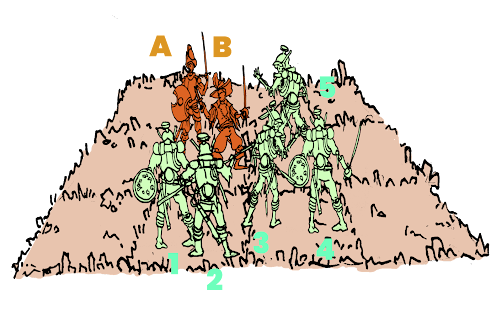
FIG 1
Defenders A & B make a narrow line, attacked by 1-5
A
is in melee with 1 & 2.
B is in melee with 1, 2 & 3
B
has been FLANKED by 5
4
is not in melee combat

For those defending doorways this is significant, the lone defender is able to prevent the enemy from flanking, but still faces multiple (up to 4 plus any from the enemy's rear rank) attacks each round. For larger groups attempting to block an advance it is always better to defend behind the doorway allowing and attack single (See Fig. 2)

Monday, December 19, 2022

Dungeon Design, Process and Keys

DESIGNING  
FOR  DUNGEON
23
With my decision to work on Dungeon23 coincides my starting a public Crystal Frontier Campaign and being dissatisfied with the progress I've been making to various new projects. I've got three large, rather experimental dungeons about 1/4 - 1/2 finished (including art and layout), and a smaller one of about 20 rooms 2/3 done, but they've just refused to come together this year. Hopefully at least the small one will be out sometime. So I've had lots of reasons to thinking a bit about how I personally design dungeons and adventures again - not as a theoretical exercise, but because I need to write some new, satisfying dungeons.

Below are some notes on my personal quick technique for getting something together for play at my table and (after a lot of additional polishing) for publication. I hope they can be of help to newer designers thinking about giving Dungeon23 a try (or really just writing up a dungeon to crawl).  As always they are for the classic dungeon crawl style of play: exploration supported by procedural turnkeeping, supply, and randomized risk. They are likely the entirely wrong way to write an adventure that will make really good live action Youtube or help you run a Vampire the Masquerade campaign, I don't pretend to know how to do either of those things. 

NATURALISM
I’m a naturalistic, or maybe even ‘organic’ designer.

This has nothing to do with whole grains. As a style of adventure design, what I’m calling organic is an expansion of what's often described as “Gygaxian Naturalism” because Gygax discusses it in “The Campaign” section on pages 86-88 of the 1st edition Dungeon Master’s Guide. While the focus is usually on Gygax's creation of a fantasy ecology, I'd say he goes further and offers an approach to making dungeon adventures that form a logical whole.

It’s also obvious to me that this was Gygax’s personal style of adventure design, meaning naturalistic design was extremely important to the success of Dungeons & Dragons and roleplaying games more generally. Organic design shows through clearly in Gygax’s best work, his most memorable adventures such as Keep on the Borderlands (B2) and Against the Giants (G series). While these adventures might not appeal to everyone today, in praising them it’s important to look at them compared to other design options at the start of the hobby. Arneson’s original Temple of the Frog as included in the Blackmoor supplement for OD&D and Wee Warrior’s Palace of the Vampire Queen by the Kerestans are great counter examples.

The naturalism and coherence of Gygax’s adventures sets them apart, he focused on the dungeon space as interconnected by logical relationships, sometime ecological, but often political or historical. His contemporaries produced dungeons that were far closer to a board game sytle series of encounters, or as the afterthought to a larger scale political and military conflict (which Arneson did design quite naturalistically). The mead hall of Gygax’s giant chief makes sense as a location, structurally, thematically, and as an adventure. Its rooms have clear uses and a sensible layout within the larger fictional space. Its inhabitants relate to each other and have uses for the spaces they inhabit. While Gygax's dungeons are far from realistic, and can become odd at times there’s almost always a thruline of sense and purpose that can only come from the conscious effort to build a dungeon around its inhabitants and a theme. As affirmed in his Dungeon Master’s Guide, Gygax doesn’t want to overthink the logic of his dungeons as a simulation, but to create a plan and structure a location that are comprehensible to and and exploitable by the players. You can poison the giant’s stew in the Steading of the Hill Giant Chief because the kitchen and feast hall exist as part of a sensible and coherent whole—that’s Gygaxian Naturalism (though the term is also used sometimes to describe a group writing process). Jennell Jaquays, tentatively with F'Chelrak's Tomb (1976), and notably in her later adventures Caverns of Thracia and Dark Tower (less effectively), expands on Gygaxian Naturalism quite successfully. Her designs start the practice of layering history and increasing the density of description, the level of interactivity, significance of faction relationships, and spacial complexity of dungeons making them more functional for exploration.

In some circles, Gygax’s other major contribution to adventure design is more popular - procedural generation. Appendices A-H of the Dungeon Master Guide are one of the first (they date back to Strategic Review/Dragon, Issue 1 as a way to play D&D solo) efforts to define this technique - providing a means for a dungeon to build itself through random dice rolls.

I’m not much of a fan. Here’s why.

I’ll acknowledge that procedural generation can be useful as a springboard for ideas or to fill space in a hurry when nothing better is available (such as when your players move off “the map”), but randomly generated rooms are either too vague and disconnected for anything more than board game style play, or require such complex tables that the designer might as well just produce a much larger keyed adventure with the amount of space and ideas. Relying on random stocking almost always means that the details and complexity need to be filled in, and the random design expanded and rationalized. You’ll still end up describing, keying, factionalizing and connecting the parts of your dungeon for it to function well. All procedural generation does is add the step of randomly generating elements of the space that have to be revised to give the dungeon coherence.

These are the basics of what sort of dungeons I want to write. Classic keyed spaces with a high degree of coherence, interactivity, variety, a layered history (useful and discovered via clues in play), navigational puzzles, and both description and themes that go beyond those of typical Gygaxian vernacular fantasy or the contemporary expectations of standard fantasy settings.

Sunday, March 13, 2022

DUNGEON!, STRATEGOS, AND D&D


Stumbling Towards D&D's Alternate, Alternate Combat System
 
The combat mechanics of Classic fantasy RPGs are a huge source of both debate and game design innovation. The first official changes to Dungeons & Dragons in “Supplement 1 - Greyhawk” are changes to combat mechanics (variable Hit Dice, including weapon damage and Hit Points by class) that form a central aspect of every subsequent edition of Dungeons & Dragons. Even now D&D's combat rules continue to evolve, increasing in complexity and offering ever more variability, steadily accreting to form the 100’s of pages of rules, customization options, feats, spells and mechanics that allow the current edition to function almost as a tactical game of fantasy superpowers and feat usage.

I’m not going to catalog, debate, or mock these early design choices. Like most of early Dungeons & Dragons the combat system is entirely functional, and while, like all novel inventions it can be streamlined or optimized in various ways, it serves. Of course what’s also fascinating about the system offered in the first edition of D&D is that it’s presented as an alternate but it was adopted almost exclusively by early players, by many presumably because they didn’t own the recommended rules in Chainmail. Both Gygax and Arenson, in the Greyhawk and Blackmoor supplements, start fiddling with it almost immediately. Other groups also begin to transform Dungeons & Dragons very quickly, often starting with the combat system, but retaining its core assumptions … the deep DNA of hit points, distinct hit and damage rolls, and damage based on weapon type, can be found even in contemporary video games. The haphazard alternate combat system offered because the preferred one (at the time) was already published, too lethal (per Arneson), and too complex to include in the modest booklets of early D&D, has become the model for the majority of mechanics in role playing games -- your Fromsoft console protagonist still fights like a 1970’s tabletop ironclad, battered into sinking by enemy blows.

Tuesday, February 22, 2022

CRYSTAL FRONTIER - GYGAX '75 PART 1

A draft cover for a potential
Crystal Frontier adventure
A purchaser of Tomb Robbers of the Crystal Frontier recently asked me how the adventure might fit into a larger setting. Specifically they inquired about the "Warlock King", ruler of the Bull Kingdom - who claims sovereignty over the Frontier but doesn’t seem to project much power into it. The Warlock King and Bull Kingdom have been mentioned in a couple of Crystal Frontier adventures, notably Marble Eye, the Bruja in The Bruja, The Beast and The Barrow is a refugee from the King’s court, hiding in exile from the his demonic assassins. Other then that we know of the King and his nation only through Jolly Diamond, the Bull Kingdom’s agent in Scarlet Town, a bad gambler and sore loser whose loyalty is enforced by a “demon mark” on his chest. There’s a few other tidbits of information about the Bull Kingdom and Warlock King scattered around Tomb Robbers, but nothing much, it’s largely a Swords & Sorcery cypher ruled by a powerful wizard who has a sinister reputation.

This is as it’s meant to be. Tomb Robbers of the Crystal Frontier is a stand alone product, a dungeon with a minimal amount of setting to supplement it and maintain a Fantasy Western aesthetic. Hints and implications rather than a gazetteer with detailed descriptions.

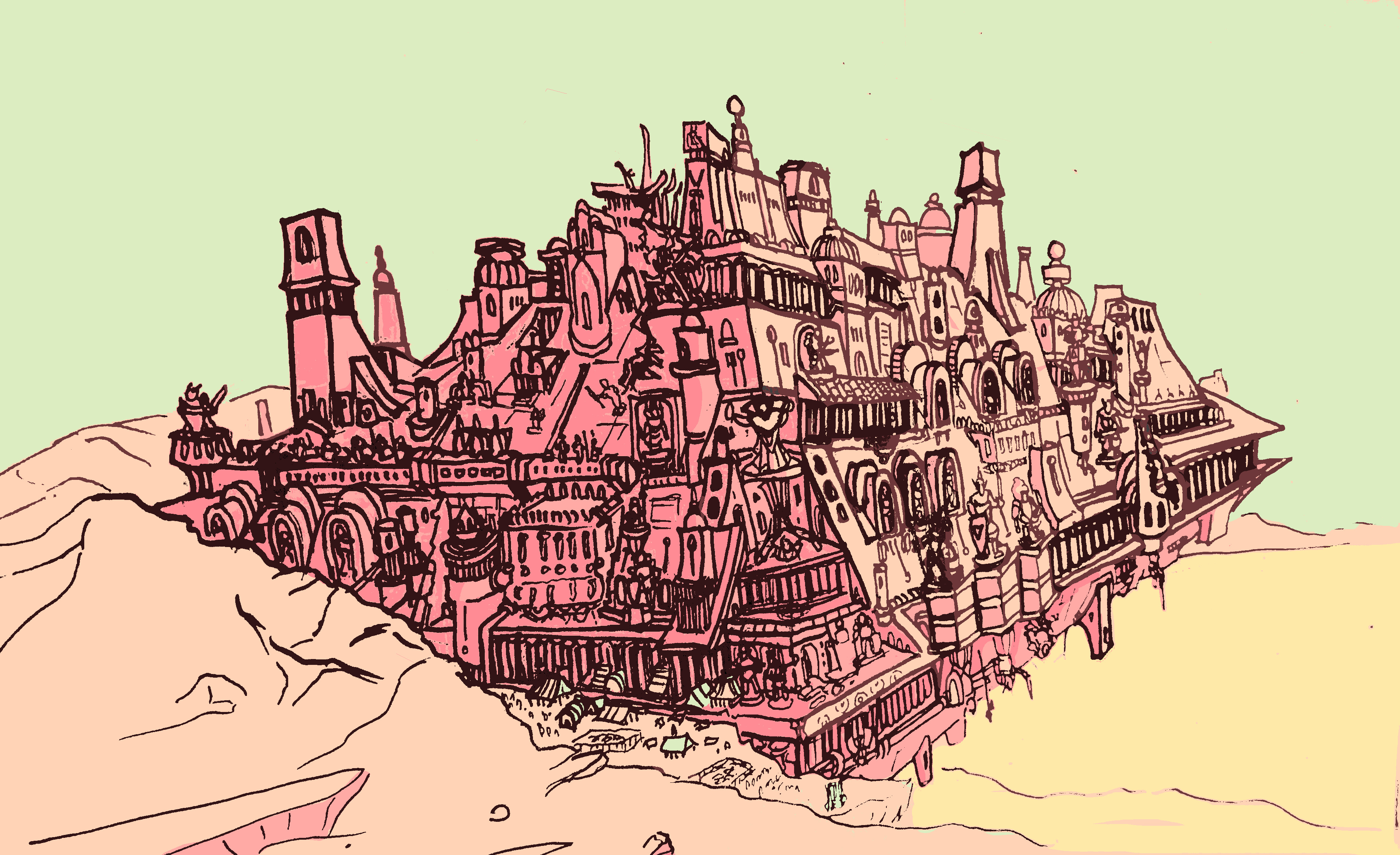
Yet, The Crystal Frontier has been my home campaign for over a year, getting on to 25 sessions, with a 3rd and 4th level party. I’ve also written or at least written up notes on several more adventures for the setting, including the two large projects I’m working on currently covering the Frontier’s North Eastern coast, where fewer crystals fall, but the old history of the land is closer to the surface. So, while there’s only minimal published information on the Bull Kingdom and its Warlock King, The Successor Empire and its Syndicates, or the environs of the Crystal Frontier at large, I have a great deal of knowledge about it. For example I currently have enough notes and rough maps to quickly prepare, or run the following Crystal Frontier locations: The Tower of Musk (A manticore lair), Old Argento (Ruined former provincial capital), The Palace of War (A crashed yet mostly intact Empyrean invasion fortress/megadungeon), Cold Manse (ghoul infested haunted mansion), the Tower of Flints (pirates, owls, and a shrine to an Imperial sea god), Cold Water Hamlet, Stone Quay (a port ruled by cattle drovers), The Palace of Reflections (an extradimensional Empyrean villa accessible via a magic scroll and infested with a blue wyrm of unreason), The Bone Fields (ancient barrows being dug up to obtain ancient magic infused bones for fertilizer) and The Dead Colossus (a walking castle destroyed by the Warlock King himself during his ascent to power). Some draft art for these location illustrates this post.

I won’t reveal much detail about these locations or the factions and histories underlying them unless I get to publishing them as adventure locations (which is honestly unlikely in most cases), but I’m quite happy with this situation. These locations have evolved through my home game, and emerged from play because they make sense based on player interest and actions as part of what has been a largely emergent setting. Other people don’t need many details of the entire setting region, let alone the world its part of to run my adventures, and it’s likely best if they take the time to do their own world building as needed, taking or discarding the hints and vague outlines that my adventures provide.


Worldbuilding & Gygax ‘75
Setting is one of those popular aspects of RPG design that I enjoy immensely, but also don’t really find much use for. Like me, it seems that many referees and designers enjoy building their world, filling it with detailed minutia, histories, locations, and people. I’ve always found this both inevitable and secondary to, or worse inhibiting of play. There’s a great deal of advice on “world building” offered on blog posts and published in guides. Even most editions of the Dungeon Master’s Guide seem to contain a huge amount of suggestions about it. I don’t want to do that and I don't for my home games. At least not in the ways that it’s popularly suggested. I want the world of the setting to weigh lightly on my campaigns, to come through during play, but not demand a great deal of fidelity to some sort of “setting bible”. Instead my settings, especially anything I offer to others, should have big holes and unexplored spaces for me or another referee to add whatever they like. Most world building advice rejects this goal, and is often very “top down”: starting with the world, it’s cosmology, gods, and continents. This seems wrong to me.

I even made a little logo for
this nonsense!

Instead I like to approach things on a "just in time" basis, build from the ground up, design with the goal of creating what’s needful for play for the first session and building up from their. Back in 2013 I wrote a long post about this sort of setting design, but there’s a fine antecedent, the “Gygax ‘75” process, derived from a 1975 interview that Gary Gygax gave to a fan magazine, “Europa” titled “HOW TO SET UP YOUR DUNGEONS AND DRAGONS CAMPAIGN - AND BE STUCK REFEREEING SEVEN DAYS PER WEEK UNTIL THE WEE HOURS OF THE MORNING!

I am usually not especially charitable to Gygax, I find his rules fussy, his ideas about refereeing antagonistic, his public behavior fairly odious (the litigiousness alone!), his writing frustrating, and the cultish fawning over him that still persists in parts of the hobby disgusting. However, Gygax also produced excellent adventures and championed the hobby of fantasy RPGs to great success and with obviously sincere love and conviction. I may not share his weird fixation on polearm variety, but I do appreciate that from the very dawn of a hobby he was one of the its primary inventors who got many things right in ways that have sometimes been too casually discarded. One such thing that Gygax did better then more contemporary sources (such as the 5th edition Dungeon Master’s Guide, which starts with a section titled “A Master of Worlds” and immediately leaps into designing a multiverse or entire world as a setting, cosmology first) was give setting design advice.The Gygax Dungeon Master’s Guide has a section about mid way through, “The Campaign” that begins with:

“What lies ahead will require the use of all of your skill, put a strain on your imagination, bring your creativity to the fore, test your patience, and exhaust your free time …Your campaign requires the above from you, and participation by your players. To belabor an old saw, Rome wasn't built in a day. You are probably lust learning, so take small steps at first. The milieu for initial adventures should be kept to a size commensurate with the needs of campaign participants … This will typically result in your giving them a brief background, placing them in a settlement, and stating that they should prepare themselves to find and explore the dungeon/ruin they know is nearby.”

Excellent and still trenchant advice which is better laid out and elaborated in the 1975 interview a few years prior. The “Gygax ‘75” process has become a bit of a regular challenge among designers who work with older editions of D&D, and it’s well explained here at DIY & Dragons. It’s also starting up again among several bloggers I enjoy, and spurred by the question regarding the Warlock King I’ve decided to apply it to the Crystal Frontier!

Sunday, August 29, 2021

Classic Vs. Five Rooms

FIVE ROOMS DON'T MAKE A DUNGEON

This blog is largely devoted to repeating a single message about game design, hammering away at the same subjects for what I hope is a growing audience. At times it feels repetitive and foolish, but then when one looks out into the larger Roleplaying Game community there’s still a lot of confusion about these same subjects -- the “Dungeon Crawl” style of play.

So once again what is a Dungeon Crawl? Why might some adventures or play styles that call themselves Dungeon Crawls fail to deliver on the promise of the genre? To explore this topic I’ll discuss a design exercise/theory and adventure format popular in the Contemporary Traditional community, the “Five Room Dungeon”. To some extent this distinction is one of definition, but I think it’s a useful distinction as it will hopefully introduce some players to the Classic style of play or at least provide tools to think about the differences between play styles and examine what sort of experience one’s table provides.

The Contemporary Traditional community has its own ethos of play, values, design principles, preferred mechanics and of course play style, and my goal isn’t to pass judgment on them, denigrate, or otherwise offend. Rather I want to present some reasons why designing and playing following the Five Room Dungeon format may not feel much like dungeon exploration and why it doesn’t fit within the (or my) definition of a Dungeon Crawl derived from or following the Classic play style found in such adventures as Caverns of Thracia.

This is all certainly not to say that Five Room Dungeons are bad or don’t work for the play style that they are designed for, only that they aren’t a panacea for adventure design or a great place to start when learning about Classic play or the Dungeon Crawl. To help understand why, it’s necessary to describe what goes into a Dungeon Crawl, or perhaps a “Crawl” more generally, as the Dungeon Crawl shares key elements with wilderness adventure designed as Point, Hex, or Wave Crawls. The basic structure of the Crawl style adventure contains three elements: Space, Exploration and Procedure.

Crawling Into the Past 

What does the Dungeon Crawl promise? To some it’s a label for any adventure set in an underground maze or even any fantasy adventure regardless of design and mechanics. To me and as used here, the Dungeon Crawl label implies something more: an adventure in a complex environment filled with danger: traps, monsters, secrets and mysteries -- something beyond just combat or NPC interactions where the location and environment is an important character in the game. Focusing more narrowly, the simplest definition I have for a Crawl as a set of design principles is to say that it’s a play style or adventure where the locus of play is:

A fantastical SPACE that is EXPLORED PROCEDURALLY.

I’ll be looking at each of these elements a bit individually, and they may already be familiar to regular readers of All Dead Generations, but I’ll only be discussing the definitions and how the elements work holistically rather than the details of their history or supporting mechanics.

Saturday, June 19, 2021

Classic Vs. The Past

A PDF of this 60 page adventure is available on DriveThruRPG.  An introductory delve into a densely interactive classic dungeon crawl designed with contemporary sensibilities.


RPGS Aren't Played As They Were In The 1970’s And Even Classic RPG Design Must Grapple With It!

All Dead Generations is a blog about “Classic Gaming”, something that Retired Adventurer’s “Six Cultures of Play” essay in April identified as “oriented around the linked progressive development of challenges and PC power, with the rules existing to help keep those in rough proportion to one another and adjudicate the interactions of the two "fairly" … The focus on challenge-based play means lots of overland adventure and sprawling labyrinths and it recycles the same notation to describe towns, which are also treated as sites of challenge.”

While the essay notes that I use the term Classic to perhaps describe something different then it’s version of Classic play, I’m not sure I fully agree. Yes, All Dead Generations frequently suggests rule variation from the primary sources of what Retired Adventurer identifies as the Classic style (AD&D and 1981’s Moldvay/Cook Basic and Expert books) and certainly my preferred aesthetics of phantasmagoric Western or opium fever Dunsanyian fantasy are somewhat far removed from the Gygaxian vernacular fantasy of gray stone corridors full of orcs that make up most classic adventures, but as far as ethics of play and play-style goals I place both All Dead Generations and my adventure design firmly in the Classic tradition. Why the distinction then? There are certainly still plenty of designers working with the Gygax aesthetic, and perfecting adventure design that reflects back to Keep on the Borderlands or even Castle Greyhawk. I’m not, and moreover the entire purpose of Jewelbox Design is somewhat antithetical to the maximal dungeons traditional for Classic play.

I’d argue that All Dead Generations and my current dungeon design seek to offer the same sort of “progressive development of challenges” and fairness that are the core of Classic design, but make them functional for contemporary play. By contemporary play I don’t mean 5th edition Dungeons & Dragons or its design principles, I mean the actual physical conditions that most RPGs seem to be played in in 2021. Two or three hour sessions, played at most once a week seems the modern standard, especially for online play. This is very different then how Gygax and other early designers appear to have run their tables and visualized play. While it’s a bit hard to pin down the exact length of Gygax’s sessions for Castle Greyhawk, Gygax notes in the April 1976 issue of the Strategic Review that:

“It is reasonable to calculate that if a fair player takes part in 50 to 75 games in the course of a year he should acquire sufficient experience points to make him about 9th to 11th level, assuming that he manages to survive all that play. The acquisition of successively higher levels will be proportionate to enhanced power and the number of experience points necessary to attain them, so another year of play will by no means mean a doubling of levels but rather the addition of perhaps two or three levels. Using this gauge, it should take four or five years tosee 20th level. As BLACKMOOR is the only campaign with a life of five years, and GREYHAWK with a life of four is the second longest running campaign, the most able adventurers should not yet have attained 20th level except in the two named campaigns. To my certain knowledge no player in either BLACKMOOR or GREYHAWK has risen above 14th level.”

The important context here is that while the number of sessions played is somewhere around one or two a week (though Gygax apparently ran Greyhawk more often with different groups), the length of the campaign is assumed to be many years. The length of session also seems to have generally been far longer. The original announcement for Arneson’s Blackmoor campaign read “There will be a medieval "Braunstein" April 17, 1971 at the home of Dave Arneson from 1300 hrs to 2400 hrs with refreshments being available on the usual basis.... It will feature mythical creatures and a Poker game under the Troll's bridge between sunup and sundown.” An eleven hour game session. One assumes that Greyhawk ran on a similar basis, at least on the weekends, and even on weeknights and for younger players at least 4 to 5 hours.

Given this disparity in time, both of the individual sessions and the length of campaigns, it’s very unlikely that the classic megadungeons of Greyhawk and Blackmoor, or even shorter published adventures like Tomb of Horror were approachable in shorter, less frequent sessions. In an interesting example, the 1975 Origins I run of the Tomb was supposed to be two hours, though famously only the a level “Evil lord” and 14 orc retainers played by Rob Kuntz finished it with a virtuoso display of calculating orc sacrifice that took 4 hours. This 1975 edition of the Tomb was lengthened for commercial release, with more complexity and puzzles added that greatly expanded play time.

Kuntz’s delve into the Tomb of Horrors varies from another aspect of early play that’s different from present conventions, Robilar the Evil Lord completed the Tomb of Horrors solo, with a large number of retainers. While there’s several stories of similar solo play or adventures for small numbers of drop in visitors, the party size that explored Gygax’s castle Greyhawk during it’s long weekend session ranged up to 10 or 20 players. As anyone who has run a group of that size can attest, organizational efforts and decision making take longer, but the party’s ability to handle threats (combat especially) are vastly improved. Contemporary, and especially online play, depends on smaller parties. Rime of the Frost Maiden, a recent WotC campaign, is designed for four to six players, compared with the six to nine players Keep on the Borderlands suggests.

While they overlap at the edges, and vary, all three of these circumstantial elements: campaign length, session length and expected party size are generally smaller in contemporary play. The limitations imposed by technology as well as different expectations of how rpg play will work have changed since the mid 1970’s. While none of these 2021 conventions are worse or better then those of 1976 they do militate for a different style of adventure design and perhaps rules modifications that account for shorter sessions.

Monday, March 29, 2021

So You Want to Build a Dungeon?

You want to write a dungeon adventure for a classic style roleplaying game, and you want it to be good. How does that work?

What exactly does a “dungeon” imply and what is it as a game tool?

A dungeon is a specific kind of adventure, one that has its own form and which requires certain elements to be successful. More, a dungeon is a “location based adventure”—an adventure that will involve the exploration of a fictional space room by room. It’s certainly not the only kind of roleplaying adventure, but it’s the primary kind for a particular exploration, navigation and problem solving style of play that is both the oldest and still a compelling one. A dungeon must be a fantastical location, but it need not be an underground maze or cave system: buildings, shipwrecks, space stations, castles, formal gardens or the corpses of an enormous beast all make fine dungeons.

What is necessary for a dungeon adventure is to create a bounded fantastical space, “Rooms”, linked together in some order that the players can freely navigate: backtracking, turning, and determining routes. Within these Rooms the designer places obstacles and rewards. Traditionally this means a series set of stone corridors and chambers filled with monsters, treasures and traps. However, neither the aesthetic of the space or the nature of the inhabitants, valuables and challenges within are fixed elements of design, and reinterpreting the dungeon space can make for a novel and exciting adventure.

Likely when you decided to write an adventure you already had a story in mind, and that’s good, but since location based adventure is about the players’ decisions, that story will recede into the background. Given freedom to scheme and explore, players are as inventive and truculent as a proverbial herd of cats, and trying to force or trick them into telling a specific story is about as successful as ring-mastering a cat circus. Rather than a story, consider your ideas a “Theme”, one that will inform the “Ecology” and a “Layout” or map that together define the dungeon adventure. Putting a plot to it is likely to fail when the players, unaware of the plot, follow their own interests. This is the joy and burden of location based classic dungeon crawling, that its story has to evolve from player decision.

The most dangerous part of a designer’s story is a climax or ending because it’s very hard to include one without making dangerous compromises to the dungeon adventure form. Narrative beats make assumptions about how the characters within a story will act, and become very difficult to maintain when those characters’ decisions are being made by someone other than the author. Players decision making is unlikely to bind itself to even as simple a narrative structure: incident, rising action, climax, falling action and resolution. The players may decide that they wish to avoid the climax’s confrontation by siding with the antagonist or they may simply turn away from the rising action as they become distracted or the risk seems too high and the rewards uninteresting. Instead the dungeon designer is best building only the space for a story to unfold, and relying on the players to determine the narrative within that story.

NOTE: There is now a more in depth sequel to this post primarily about Dungeon Keying.

Old Games

Let’s talk about old tabletop roleplaying games - specifically the kind of games played in the 1980’s and recently depicted in the nostalgia...