Showing posts with label Old Games. Show all posts

Tuesday, November 5, 2024

GYGAX'S FORTRESS

Gary Gygax is probably the best known name in Role Playing Games -- still, nearly 15 years after his death. Considered Dungeons & Dragons’ co-inventor and principal author of most of its early material, “Uncle Gary” was also a tireless promoter of his game and of role playing games as a whole. For the hobby’s ½ century Gygax’s name has been synonymous with it, he shouldn’t need an introduction, but it's still worth taking a close look at his adventure design legacy. Specifically how Gygax designed his dungeon adventures.

Gygax was author of many of the best early adventures for Dungeons & Dragons including: Steading of the Hill Giant Chief, Vault of the Drow, Village of Hommlett, Expedition to the Barrier Peaks, Tomb of Horrors and of course Keep on the Borderlands, likely the most played Dungeons & Dragons adventure of all time. While some of his adventures, such as Expedition to the Barrier Peaks and Tomb of Horrors, were at least significantly the work of others (Kask and Lucien respectively), though Gygax undoubtedly had a hand in them as well. His output was prodigious and his foundational adventures are still well known today. I’d argue that adventure creation, rather than rules of mechanics, was Gygax’s greatest strength as a designer. With Arneson, Gygax wrote a system of adventure or dungeon design into the 1974 edition of Dungeons & Dragons, but he didn't follow it long, and certainly not in his published work, instead innovating and diverging from his own early advice to pioneer a new style of adventure design. Yes, his most important contribution to the hobby was likely organization and promotion - and the hobby of role playing games owes him a great amount of credit, perhaps even its existence for his efforts there - but Gygax’s adventure design still stand tall a half-century later, and it's full of useful lessons and techniques. 

Gygax Design
Like all good designers, especially early in the hobby, Gygax’s design has its own flavor and concerns. For Gygax adventure design is most often focused on the nature of the forces opposed to the players and potential environmental factors or conflict among these enemies that the players can exploit. He was first a wargamer, and his signature adventures are far more “sieges” or “infiltrations” then they are “explorations”, though this is not universal or absolute. Gygax’s adventure writing itself is marked by an relative indifference to map design, and the use of sparse keys that offer the minimum of environmental detail while focusing on the monsters encountered and their military strategies or behavior.

Gygax designed a variety of scenarios over his long career, but the central challenge in Gygax’s best known adventures, at least the ones where he’s clearly the sole designer (again, not Tomb of Horrors or Expedition to the Barrier Peaks) is one of military tactics or strategy. In a Gygax adventure the party will succeed if they can outwit, destroy, suborn, or bypass a hostile, organized force more powerful than them. Examples of these forces include the giants in the Against the Giants modules, the humanoid tribes in Keep on the Borderlands, or the mountain giant and his flunkies in the Forgotten Temple of Tharizdun. In all cases the party is unlikely to survive a direct confrontation with the forces against them, and instead needs to use schemes, things they discover about and within the dungeon, or subterfuge to overcome them. Often these solutions require that the party access the enemy base/dungeon without alerting its guards, and then conduct a campaign of theft, assassination, and sabotage within.

The siege or infiltration scenario is natural enough, it’s the sort of thing that naturally evolves from skirmish wargaming -- where one wants to justify both a small group of characters and provide their player(s) agency within the context of a larger military conflict. In 2002, during a Question & Answer session on ENworld’s bulletin boards Gygax rejected idea that Dungeons & Dragons had an exact analogue to military siege scenarios, stating that “no actual D&D game module I've ever seen has taken the base, sieges, to the 'commando' raid stage, either in infiltrating a fortress of for breaking out of one to wreak havoc on the besiegers lines.” However, Gygax liked the concept, and claimed to be writing an adventure based on the scenario of infiltrating a fortress during a siege … his rejection of the idea appears more one of exacting terminology than to the suitability of the design itself. Setting aside the context of a strictly military “commando raid”, it’s obvious that Gygax often wrote adventures centered on infiltration as a part of a violent conflict - ambushes, evasion, assassination, and sabotage. While there are elements of dungeon exploration involved, including entire adventures written using other design forms, the infiltration scenario is distinct, and Gygax perfected it, even creating special tools to run it more efficiently. 

When interrogating this style of design, the first thing to notice is that the primary source of tension in a Gygaxian Siege is not supply depletion or the pure risk of random encounters, but the larger risk of an alarm being raised. Once the fortress is alerted the adventure will change almost fundamentally as the enemy forces begin to actively patrol, reinforce each other and gather at choke points. A siege adventure is not usually a race against the steady depletion of character resources like the traditional dungeon crawl, but an effort to get as close to one’s goals before the alarm is raised and the enemy begins to hunt the party.

Monday, October 23, 2023

Dungeon Skrimishing

TACTICAL COMBAT MECHANICS for Theater of the Mind Dungeon Crawls

Front Piece From the Holmes Edition - 1977

Running skirmish sized combat requires more than a party that can win with limited special abilities (such as a sleep spell or fireball), and must hold players interest by avoiding an endless grind of simple attack rolls. To do this it’s best to introduce some element of tactics. It’s important that, without resorting to true “grid combat”, one has rules for: spacing, ranks, and flanking. With these few concepts one can have simple shieldwall combat that provides both faster and more tactical skirmish size combat while still retaining the basic structure of the rules found in older editions of Dungeons & Dragons or other systems built from the same sources. These rules are also modular, and can be adapted to each table’s time needs, comfort with tactics, desire for combat options and interest in measurement or fine detail … to a degree of course. These rules are still early Dungeons & Dragons combat based on Arneson’s “alternate combat system” and use the same abstracted, simple rounds, initiative and attack rolls every Dungeons & Dragon player is familiar with. A significant advantage for my own games is that this set of additional rules don’t require grid-style combat -- the concepts of line, rank and spacing are largely self-contained, self-relational and intuitive to a degree that with a little practice they are easy to run from even gridless maps or a vague sketch of a random wilderness area. That is, these are “theater of the mind” combat rules.


Simplified and Fantastic Pre-modern Combat. Here is a set of mechanics and a procedure that allow some tactical complexity with the limitations of the fairly simple and abstract combat mechanics of older, exploration focused systems, without the necessity of a grid or measurements. They also badly mimic the basic ideas behind pre-modern combat, based on the shieldwall tactics of classical Mediterranean infantry armies and even more a simplified and vague cinematic interpretation of the warfare between warbands in Europe of the Migration Period and Early Middle Ages. They are undoubtedly incomplete and historically wrong in several ways … but they have worked for me to offer a comprehensible tactical system that doesn’t require a complex grid and token system.

Combat occurs between two lines of armored (and often shielded) combatants facing each other so that each front line fighter limits the number of opponents they face and can avoid being flanked
Less well armored combatants either take up positions behind the front line in ranks to attack over their shoulders with spears and polearms, or extend their side’s line in an effort to flank the enemy line.

RANGES AND DISTANCE The dungeon is almost always a cramped place and dungeon combats tend to take place at very short distances compared to field battles. There is no room for cavalry, artillery, push of pike, or even much for missile fire. Because of this the exact measurements or even the grid of a war game are less necessary and estimated “range bands” can be used if they are easier to imagine and remember. As with turn keeping vs. time keeping, remember that the characters and players are unlikely to know or care if their heavily armored foes at the other end of the hall are 42’ away or 37’ — only if they are in range to charge this round. Instead of calculating the 40’ combat movement rate it’s more efficient to consider distance in terms of simple distance categories: Close (grappling or 0’), Melee (in melee strike range or 5’), Reach (attack range for spears and polearms or 10’), Charge/Medium (Distance that can be closed with a charge attack; 10’ - 40’), and Long (beyond 40’ usually outside of torch or lantern light distance, requires a round at least to closer to Charge distance). The referee should estimate distances based on a quick glance at the map (its distance grid can help, but isn’t absolutely necessary), but for it to work the players need to trust and accept the referee’s adjudications rather than argue for advantage.

These range bands still support existing combat mechanics, such as ranged weapon bonuses, the referee just needs to describe ranges and distances in terms of the immediate concerns of the players rather than distances in feet or meters. Explain “What can attack the characters and what can the characters attack” without the intermediate issue of calculating distances. Some detail and granularity may be lost, but for most combats, especially dungeon combats, these estimations are sufficient, far quicker, free the game form grid combat, and leave less room for meta-gaming tiny distances.


MISSILE COMBAT Bows, crossbows and other long range weapons are extremely dangerous to fire into melees and are usually limited to either an initial volley or two as forces close. Thrown weapons can be modeled in a more interesting tactical manner that somewhat mirrors the use of thrown spears in Hellenistic and Roman combat, or hurlbats and francisca by Northern European warriors such as the gallowglass until the 16th century.

Firing into Melee. In an open field battle where opposing forces advance across the field from hundreds of yards, or in a siege long range missile weapons such as bows and crossbows are deadly and effective… in the close darkness of a dungeon, they are rarely useful for more than a couple of shots before melee commences.


Missile weapons can always be used normally prior to melee combat and fired from any rank, but the risk of injuring or dangerously distracting one’s allies is quite high.  When firing into a melee (even at enemies in the second or deeper ranks) a natural attack roll of five or under (modifiers don’t count), will strike the ally nearest the target (or alternatively distract them allowing their opponents to strike them) inflicting its damage on the ally.

Optional Rule: Reactive Thrown Weapons Thrown off hand weapons such as hurlbats, plumbatas, piling, or throwing knives, which can be used in reaction to and attack. Held in the off hand these thrown weapons allow a trained Fighter or Thief a ranged attack as a new enemy moves to engage them in melee.

A Reactive Attack is made just like a normal attack, but interrupts the initiative sequence, and allows the combatant with the drawn thrown weapon to attack prior to an enemy moving into melee.  This attack can only be made immediately prior to the enemy’s first attack or charge, thrown from a foot or two, it is otherwise as a normal attack. Reactive attacks are not allowed as an additional attack on the combatants own action (though the throwing weapon can be used as normal if missile combat is an option). A reactive attack with a thrown weapon does not provide time for the combatant to draw an additional weapon, pick up a shield, brace against a charge or otherwise perform any additional acts prior to the opponent's action.


LINES
Lines are one or more combatants armed with a melee weapon who controls an area and prevents up to two enemies directly in front of them from passing them.  While it’s possible to break or flank a line, an enemy armed with a regular melee weapon cannot pass it or attack anyone except for the 2-4 enemies directly in front of them in the enemy line. In a dungeon skirmish lines are often anchored by a wall or other obstacle, and so become impossible to circumvent (or flank). Each human sized combatant takes up and can protect 5’ of space (or half a map square) (See Fig 1.), unless they are in a doorway, in which case they can cover up to 10’ of space (See Fig 2. This means that two defenders are required to form a line across most corridors.


A combatant in a line formation can attack enemies in the 15’  in front of them, including the right or leftmost enemy in the next line segment. This means that the most enemies a combatant in a line will face directly is three (Fig.1) ... well four if they are in a doorway.

FIG 1
Defenders A & B make a narrow line, attacked by 1-5
A
is in melee with 1 & 2.
B is in melee with 1, 2 & 3
B
has been FLANKED by 5
4
is not in melee combat

For those defending doorways this is significant, the lone defender is able to prevent the enemy from flanking, but still faces multiple (up to 4 plus any from the enemy's rear rank) attacks each round. For larger groups attempting to block an advance it is always better to defend behind the doorway allowing and attack single (See Fig. 2)

Friday, August 4, 2023

7 Maxims of the OSR

Back in the aughts and the 2010’s, a decade ago now, there was a movement in older RPGs that I was part of - the “Old School Renaissance” or "OSR". The OSR still hasn’t really been defined, or at least its definitions have always been in conflict, now more than ever as it becomes a subject of nostalgic veneration. It’s uncontroversial to me (I’m sure others will feel incandescently differently) that one of the hallmarks of the OSR was the creation of instructive maxims about how to enact its desired play style. That play style in turn depended on and created an exploration focused elevation of player choice in a strongly referee controlled setting. The maxims of the OSR were commonly offered to newcomers and now linger in the communities of the PostOSR, where they are too often repeated as if they are unalterable, clear truths obvious to everyone. They aren't and they weren't. Like most maxims, aphorisms, and pithy bits of commonsense, these distillations of OSR gaming wisdom are useful … but only up to a point, and they work best as reminders for people already familiar with their goals.

Trampier from the 1st Edition Monster Manual

These days it feels like the Post OSR spends a lot of time reinventing things that people wrote on blogs in 2010, or stumbling into the same well known solutions and declaring they have "fixed" the play style. Part of this is a lack of information for people new to these kind of games, exacerbated by the lack of citations among the hundreds of retro-clones that claim to be OSR games. There's little help for this, and as much as introductions to OSR theory like Philotomy’s Musings, Matt Finch’s Quick Primer for Old School Gaming, or Milton, Lumpkin and Perry’s Principia Apocrypha are useful documents and helpful introductions, the majority of OSR wisdom exists as scattered blog posts and in the minds of people who have engaged with the play style over the past 20 or so years. People don't read blogs anymore, but even if they did ... these bloggers, designers, referees, and players have a tendency to fall back on maxims when asked to explain elements of the play style, and it’s not the most efficient way of communicating craft and knowledge.

Worse, as the actual creation of the maxims recedes into the past, clouded by memory's failings and wearing into the grooves of dogmatic repetition, they have begun to take on the force of natural laws rather than suggestions or explanations of design decisions and play culture. The power of nostalgia and orthodoxy transforms simplifications and shorthand for larger, complex concepts into definitions that are frequently misinterpreted or carried to lengths that subvert their original meaning and damage the very type of play they were meant to support.

YOU CAN NEVER GO HOME AGAIN

Maxims have such a power in the OSR because it was forced to deal with the convoluted history of early Dungeons & Dragons. It’s often, and falsely, claimed that the goal of the OSR was to play games in the manner of some ideal past table: Gygax’s basement in Lake Geneva, or “the way D&D was meant to be played”. While some undoubtedly tried, this claim and any efforts towards it that actually happened is mostly nostalgic invention, a blend of cognitive distortions and bias that includes: rosy retrospection, survivor’s bias, selective abstraction, the masked-man fallacy and the halo effect. The problem being, that even where it’s discernible through faulty memories, self aggrandizing claims, and lies made up during IP litigation, the play style of early RPGs was constantly in flux. Dungeons & Dragons showed a great deal of conflict and transformation within play style from the first, and even within the 1974 edition. For example, the "Alternate Combat System" alone suggests an entirely different play style then the combat rules for Chainmail that were originally intended for the game. Worse, depending on one’s prior experience or influences a variety of play styles and design approaches all seem to fit within the description of “Old School” RPGs. The bloggers, referees, forum wits, and designers of the OSR struggled to articulate exactly what they wanted, which wasn’t uniform among them in the first place.


Instead of representing a “rediscovery” of a fully functional set of rules, procedures, design ethos, and play culture of Gygax's golden age -- somehow lost or destroyed by some ever growing cast of villains (the Hickmans, the Blumes, Lorraine Williams, Patricia Pulling and the Satanic Panic, Dungeons & Beavers, Hasbro, Vampire Larpers, Organized Play, or ... as always ... Young People), the OSR was always a place of invention, adaption, and revaluation. The OSR play style, to the degree any exists, was a new thing that evolved over time in the 2000's and 2010's, influenced by and partially formed from original early RPG texts and long-term play experiences of its members -- but necessarily taking in the various ideas and work in RPGs from 1974 to the present. Pithy maxims acted to anchor this decades-long aggregation of hundreds of peoples’ ideas and experiences into vague statements of general principle. "Rulings not Rules" is a phrase that one shares like a secret handshake, even if it's meaning isn't especially clear. Such statements are great for forming group identity (far more pleasant and long lasting than railing against a cast of villains and blaming them for a rupture from the nostalgic ideal) … but they don’t actually explain how to play the game.


7 MAXIMS to DeCODE
Maxims differ from aphorisms in that they present themselves as little truths, almost with the force of natural laws. Aphorisms instead ask their audience to think about them, and often hint at paradoxes or complexities in a way maxims don’t - and again this is where maxims are great tools for forming group identity, but less effective at teaching or giving their audience any sort of deep understanding.

The following maxims were common in OSR spaces and continue to be cited in much of the discussion around OSR and Post-OSR play style. I haven't generally listed their originators, though I suspect that most of them can be traced to a specific blog post or forum thread, largely because I am lazy, and they are always presented outside of their original context. Without it, they have changed meaning with time, and each is an effort to condense and simplify complex concepts or even arguments from or between numerous other contributors. Instead, all I can offer is my criticisms of the maxim (based on observations of how I've seen it used) and then my personal understanding as someone who was there, or at least peering though keyholes and standing in the shadows, when most of these maxims were hashed out. Generally this is a positive reading. 

Sunday, September 18, 2022

Gus L. Free Adventure Archive


I've created an Archive of all the free adventures I've written since 2012 here:


FREE ADVENTURE PDF ARCHIVE

I also wrote a paragraph about each the adventures included to place them within my own design evolution and perhaps a larger story of OSR design from 2012 - 2020.

In Other NEWS Tomb robbers of the Crystal Frontier is available as a Print on demand version, on Drivethru for $16.00 (as of 9/22 - print costs change). This version includes an area map, added art and a new supplemental adventure.

Questing Beast Youtube Review

link for purchase


Sunday, March 13, 2022

DUNGEON!, STRATEGOS, AND D&D


Stumbling Towards D&D's Alternate, Alternate Combat System
 
The combat mechanics of Classic fantasy RPGs are a huge source of both debate and game design innovation. The first official changes to Dungeons & Dragons in “Supplement 1 - Greyhawk” are changes to combat mechanics (variable Hit Dice, including weapon damage and Hit Points by class) that form a central aspect of every subsequent edition of Dungeons & Dragons. Even now D&D's combat rules continue to evolve, increasing in complexity and offering ever more variability, steadily accreting to form the 100’s of pages of rules, customization options, feats, spells and mechanics that allow the current edition to function almost as a tactical game of fantasy superpowers and feat usage.

I’m not going to catalog, debate, or mock these early design choices. Like most of early Dungeons & Dragons the combat system is entirely functional, and while, like all novel inventions it can be streamlined or optimized in various ways, it serves. Of course what’s also fascinating about the system offered in the first edition of D&D is that it’s presented as an alternate but it was adopted almost exclusively by early players, by many presumably because they didn’t own the recommended rules in Chainmail. Both Gygax and Arenson, in the Greyhawk and Blackmoor supplements, start fiddling with it almost immediately. Other groups also begin to transform Dungeons & Dragons very quickly, often starting with the combat system, but retaining its core assumptions … the deep DNA of hit points, distinct hit and damage rolls, and damage based on weapon type, can be found even in contemporary video games. The haphazard alternate combat system offered because the preferred one (at the time) was already published, too lethal (per Arneson), and too complex to include in the modest booklets of early D&D, has become the model for the majority of mechanics in role playing games -- your Fromsoft console protagonist still fights like a 1970’s tabletop ironclad, battered into sinking by enemy blows.

Wednesday, January 12, 2022

DUNGEON! & Dungeons

THE BOARD GAME - DUNGEON!
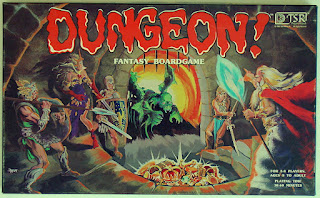
Mid 80's box cover of DUNGEON!

In the early and mid 1970’s David R. Megarry, a member of the same gaming group as Dave Arneson and David Wesley (of Braunstein fame) and player in Arneson’s 1972 Blackmoor campaign, began to play around with the concepts he learned dungeon crawling in Blackmoor to create his own game: “Dungeons of Pasha Cada”. He sent initial handmade copies were to friends and attempted to publish through Parker Brothers but was rejected. Eventually, as part of the absorption of the Minneapolis-St. Paul gaming group, Megarry joined TSR and his game was published as DUNGEON!, with Gygax, Steve Winter, and others were added to the game's authors' list.

Built from memories of Blackmoor and the Chainmail Fantasy Supplement for monsters, spells, and concept, DUNGEON!’s rules are a brew of mid-century war games rules that may ultimately lead back to the dawn of American war gaming - Charles A. L. Totten’s Strategos (1880). While DUNGEON! is first and most importantly a board game, in the context of playing old fantasy RPGs, DUNGEON! represents an alternate evolution of Blackmoor, Greyhawk and Dungeons & Dragons.

DUNGEON! was published by TSR, only tangentially part of the Dungeons & Dragons by implication, where it remains (Wizard’s of the Coast last published a version in 2014) somewhat unchanged from the early editions. DUNGEON!'s monster and adventurer selection is firmly set in the implied setting of early Dungeons & Dragons and its name and aesthetics are so similar to early Dungeons & Dragons that in the 1980’s it was often presented as or assumed to be (at least by the folks I knew) some sort of introduction to the game for the uninitiated (its rules with their add for Dragon Magazine imply this as well). DUNGEON! though is a very, very different game from Dungeons & Dragons, both in its mechanics and goals. DUNGEON! has interesting design, intentional design even, with effort put into making a fast, competitive board game that includes RPG elements such as character asymmetry and advancement.

DUNGEON! IS INTENTIONAL DESIGN
Dungeon isn’t a roleplaying game, it’s not a version of Dungeons & Dragons, or even Blackmoor - notably it doesn’t have a referee or dungeon master, it offers no open ended obstacles based on description or faction intrigue. DUNGEON! doesn’t even resemble contemporary refereeless games as it has no elements of shared narrative control or storytelling. It is just a board game, where control of setting and “story” are lodged firmly with the designer and the random determinations of the dice - the players of course have some agency in that they decide where their adventurers go and what routes they take, but it doesn’t offer control in the way that contemporary referee free RPGs like Fiasco do. While DUNGEON! isn’t a roleplaying game in the normal sense, it still contains some of the basics of dungeon exploration: navigation as a puzzle, risk and reward calculations and turnkeeping.

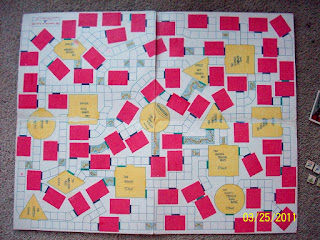
The Original Board for DUNGEON!
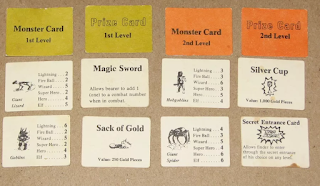
Superficially DUNGEON! looks a lot like classic Dungeons & Dragons. Its cards depict monsters and treasure in the same sort of scratchy black and white art as D&D's original booklets, the map is an underground maze (with 92 rooms!), and the names and titles of the various monsters and adventurers are the same. In DUNGEON! each player takes the role of an adventurer an elf, hero, superhero or wizard who plunges into the dungeon in search of treasure. The rest of the mechanics are very different though, and intentionally so. Unlike RPGs these adventurers are in competition, not a party that works together. Each adventurer wins when they return to the center of the map (the Main Staircase) with treasures worth a specific amount, more for the more powerful adventurers. Each adventurer can move 5 squares (rooms or the yellow blocks breaking up corridors) and each colored “room” contains a set of cards - a “monster” to fight and the “treasure” it guards.

Combat consists of rolling 2d6 aiming for a target number based on adventurer class and the monster. A second roll determines the result of a lost combat, with only a 2 resulting in the “death” of the adventurer, and 3 or 12 resulting in a serious injury, loss of all treasure, and retreat back to the stairs. That’s around an 11% chance of serious loss (most negative results end in retreat, loss of a turn or single treasure) assuming a failed first roll. Once a monster is defeated the adventurer collects the treasure or possibly a magic item that will improve their future chances by looking at cards in other rooms (crystal balls, esp medallions) or adding to their attack roll (magic swords). Wizards alone can cast spells, mostly to attack monsters without risk of reprisal. Advanced rules exist allowing players to ambush each other. 

Low Level Monsters and Treasure

These simple rules are meant to create a high risk competitive board game, they don't support character development or cooperation, and they don't present open ended problems beyond player strategy in navigating the board and judging risk. Looking at them closely, or playing DUNGEON!, it's clear how well the rules manage to deliver on this simple concept and how complex player decisions can become.

Friday, November 12, 2021

Old Work Revisited and a Free Adventure

GAZING BACKWARDS INTO THE ABYSS

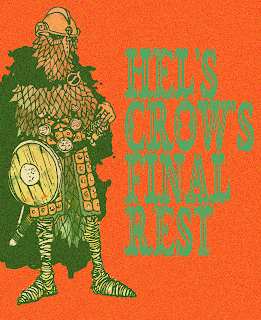
Hel's Crow's Final Rest (release) PDF

In the dingy fall of 2012, a little over nine years ago now, when I had newly returned to Classic style RPG play and the online community around it seemed full of possibility I wrote Hel's Crow's Final Rest.  The blog Ramblings of the Great Khan had put together a little contest for short viking themed adventure, and this was my two page entry. 

An RPG friend of mine, mv, has been working on improving their layout skills and asked around for short things in search of layout. I offered a few old adventures and mv picked Hel's Crow's Final Rest. Over the past several days mv and I have gone back and forth about layout and I drew some new art for the old adventure to offer it up again in a more contemporary form.

It's interesting looking back at one's own old work. A glimpse into a different time, and 2012 was a different time.  The "OSR" was a younger school of RPG design, having just emerged on Google Plus and started to merge its Revival and Renaissance into a shared conception of play. My experience with post 1995 gaming was largely limited to running Patrick Wetmore's Anomolous Subsurface Environment and playing a few of the early online games on Google Plus. Rule sets hadn't proliferated and Labyrinth Lord was the primary retro-clone. The term "OSR" wasn't even in general use and many of the personalities that would come to dominate the scene and innovate within it hadn't started blogging.  Yet in 2012 there was already a robust culture of play exploring rules light older editions of a variety of games (not just Dungeons & Dragons) and a community of creators focused on setting design, adventure creation and rules hacking shared via blog, but not yet the production of new derivative systems for sale. Hel's Crow's Final Rest is a product of this time of vigorous amateur adventure design.  It's a simple location/situation based advetnure, but strikes me still as fairly representative of the sort of small adventure in 2012 - a little compressed to fit into its original two pages, but very much an example of mid-period "OSR" design.

At its core Hel's Crow's Final Rest is a faction based negotiation built around a single encounter.  Again this is because it's not a dungeon crawl, but a short adventure. One could argue it's scene based even, but it's still designed with a location as its subject - the Sea Shrine of Aski.  My adventure designs remain focused on location, even today, and like Hel's Crow's Final Rest try to derive much of their play from faction negotiation. This necessitates unclear moral lines (which Hel's Crow has - though it has obviously good and obviously evil factions) so that there's no obvious best choice for players. Here the players are asked by a powerful evil force to recover an artifact from the shrine sheltering refugees from Aski, and can do that through trickery/negotiation or through violence.  Heroism and direct confrontation with evil in the adventure leads only to a quick and messy death, while monetary success (and thus level advancement) is far more likely to come through the characters decision to engage in evil acts themselves.

The cartoonish Norse setting reflects the grim character of this quandary - but I think manages to do so without fully embracing the "Grimdark" sensibilities that would later become an OSR hallmark.  Such dark themes and lack of clear "good" choices are a useful tool for designing with high lethality systems, producing adventures that have a high degree of player choice and moral ambiguity/decision. Such settings set player expectations by cautioning them that characters can die easily and that survival depends on making choices and problem solving.  An alternative of course has always existed in "Gonzo" settings which use absurdist humor to similar effect, and in 2012 the question of which style of setting Gonzo or Grimdark would dominate future OSR design was still an open question.

Monday, November 1, 2021

Classic Vs. Treasure, Part 1

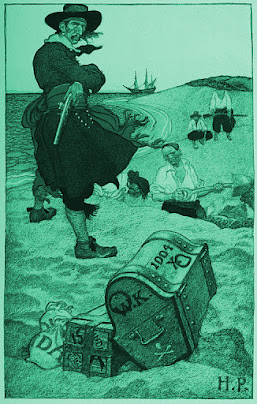
All Illustrations are
Howard Pyle's from 1883 - 1921

TREASURE TROUBLE
One aspect of Dungeon Crawl play that All Dead Generations hasn’t covered in any detail is treasure. This is an oversight, because treasure, like exploration, like encounters, and like combat is an important element of fantasy RPGs and especially important to the older style of play that All Dead Generations discusses. When we consider how treasure works in fantasy RPGs it usually seems fairly simple, even in Classic games - pick up the treasure and bring it back to civilization for experience and leveling. It is this simple, this is the gist of treasure in Classic fantasy RPGs -- pure reward ... but like everything else in the interconnected edifice of Classic play treasure presents its own complexities that interact with various important procedures and mechanics. Unfortunately the way treasure is structured in most classic systems makes it less of a reward and more of a chore, eating up play time with logistics and calculation.

The Function of Treasure
First, recovered treasure is the Classic player’s metric of success. Even in Classic rule sets that provide experience for defeating or killing monsters (something I dislike as it sends confusing messages about the goals of exploration), the majority of characters’ experience will come from the treasure recovered in the dungeon. Random treasure generation has been a mainstay of Referee preparation since the first edition of Dungeons & Dragons however, and it has an enduring appeal because imagining treasure is delightful - it’s a space where wonder can enter RPGs, this alone makes it valuable. Yet, these formative random treasure systems, as found in all early Dungeons & Dragons, reject wonder. Despite the gambling style fun of rolling up random hoards, random treasure has been largely unvariegated mass of coinage.

There are mechanical reasons for these coin hoards, coins are far easier to generate randomly and far easier to track encumbrance for. Dungeons & Dragons has also long used coin based encumbrance, with characters able to carry a few thousand coin weight (it varies by edition and represents a failure point for early dungeon crawl mechanics - see below). This ease couples well with the gambling appeal of random treasure generation, and the random “treasure types” that appeared in the 1970’s white box have endured appeal, despite most older editions cautioning against coin hoards for various reasons. However, even when a designer or referee doesn’t use random generation or design advice cautions against it the treasure tables set the standard and expectation of what treasure looks like in Dungeons & Dragons, and from there fantasy adventure as a genre.

More influentially random treasure generation in early editions of Dungeons & Dragons provide guidance about the expected speed of character advancement. For example, if the party defeats a dragon in 1981 Basic D&D and takes its hoard they will find the glorious Treasure Type H, worth an average of 50,000 GP. This of course isn’t really a linear challenge system as even the relatively weak six Hit Die White Dragon has such a hoard, while the much more dangerous saber tooth tiger (big cats are absolute terror beasts in Basic) they will get only a few hundred gold from its paltry Treasure Type V (or more likely nothing - the chances of having even d100 GP is 10%). Still, Treasure Types and random coin hoards are the main way that early editions offer referees and home designers a means of visualizing the rewards of successful adventuring and so provides clear metrics for pacing and level advancement.

Yet, treasure should be more than coins. Coins are a simple game currency that characters can exchange on a 1 of 1 basis for experience points, but “treasure” is, like fantastic locations and strange creatures, a concept that offers up the excitement of fantasy. Yet I won’t suggest abandoning random treasure generation in favor of inventing unique treasure caches as part of adventure preparation, perhaps lovingly describing each valuable object after reviewing the online collection of the British Museum for inspiration. This is time consuming fun, but it neglects an important element that makes coin hoards useful -- coin hoards work perfectly with early Dungeons & Dragons coin based encumbrance system to create complications and allow players to make informed judgments about the relative value of specific treasures.

The coin system is still of course dull, but it need not be as it’s easy to expand and cover a wider variety of treasure with minimal change, once one recognizes its mechanical basis and if one is willing to set aside some of the implied setting it creates.

Wednesday, October 6, 2021

A STRUCTURE FOR CLASSIC EXPLORATION PROCEDURE


The Procedural 

Dungeon  Crawl

The “Procedural Dungeon Crawl” gets mentioned a lot on All Dead Generations” and many of the pieces here describe its theoretical underpinnings -- but what exactly is the Procedure in the Procedural Dungeon Crawl? Not “What is Procedure?” in some abstracted way, but specifically, what Procedure does one follow to produce a Turn of Classic Exploration play?

Below are two lists that breakdown how I would run a Turn of Exploration in both a Classical way (using OSE similar clones or 1981 Moldvay Basic [B/X] mechanics) and how I actually run my own games (using house ruled 1974 Dungeons and Dragons.) Both function just fine with the other rule set however (some movement distances are different, and by the book OD&D adds procedures for incidental traps that I omit because not every square foot of every dungeon has broken pit traps in it) as they are Procedure rather than mechanics.

Before I go into detail about how and why they work, here are the “Classical” and my own “Neo-Classical” (with plentiful ideas from other bloggers and designers) methods of running an Exploration Turn as I understand them:

CLASSICAL EXPLORATION PROCEDURE

TURN BEGINS
A. Referee calculates and Players note equipment and/or status changes due to passage of a 10 minutes.
B. Random Encounter Die Events are resolved. (Can Open Encounter Procedure).
C. Referee describes surroundings (Can open Encounter or Combat Procedure).
D. Players ask questions about surroundings or events and the Referee clarifies.
E. Players state actions.
F. Referee confirms player actions with clarification of any mechanics used.
G. Actions are resolved. Any movement is calculated.
H. Players note any status or equipment changes on Character Sheets.
I. Roll Random Encounter Die for next Turn.
TURN ENDS


NEO-CLASSICAL EXPLORATION PROCEDURE

TURN BEGINS
AA Referee describes surroundings (Can open Encounter or Combat Procedure) and applies Exploration Die results from the prior Turn.
BB. Exploration Die Events are resolved and noted. (Can Open Encounter Procedure)
CC. Players ask questions about surroundings or events and the Referee clarifies.
DD. Players state actions.
EE. Referee confirms player actions with clarification of any mechanics used.
FF. Actions are resolved.
GG. Players note any status or equipment changes on Character Sheets.
HH. Roll Exploration Die for next Turn.
TURN ENDS

Monday, December 17, 2018

Old Games

Let’s talk about old tabletop roleplaying games - specifically the kind of games played in the 1980’s and recently depicted in the nostalgia driven Netflix series Stranger Things. I played a lot of Dungeons & Dragons in the 80’s - in basements on rainy days, or around kitchen tables when someone’s parents were out of town. I started playing it again in 2011 around my own kitchen table with fellow 30ish professional types out of a sense of nostalgia and then online with other fans, many of whom were also rediscovering the game after years of absence. We never really thought to play the new editions, just pulled a book (or in my case the 1979 white box set) from parents’ basements or the back of closets and started up again where we left off as teenagers.

Larry Elmore's cover from the 1983 Basic D&D Set
Only after exposure to the online classic gaming community and younger players who were more familiar with the 3rd and 4th editions of the game, World of Darkness, Pathfinder or other more modern games did I really realize how much Dungeons & Dragons had changed with its newer editions, and how much after the release of the 5th edition there was a resurgence of interest in tabletop roleplaying games. Still, I’ve been a bit shocked looking at the new adventures produced by Wizards of the Coast, the differences from the way that I learned to play and like to play are jarring. I’m don’t want to claim that all modern adventure design is bad, ineffective or leads to games that aren’t fun, but it’s often not where my personal interests lie, and there’s plenty of other people who are happy to offer advice on how to design, run and play modern style adventures. For me it’s enough to talk about how and why classic style games are designed and work the way they do and how to design, run and play them - both with older systems or mechanics, but also ideally with more current editions of the game.

To understand old games and the way they were played the first odd thing to grasp is a bit of information about the 1980’s - there was no meaningful internet. The Dungeons & Dragons community was limited to the players in one’s immediate community with a little input from the rules and modules, perusal of hobby magazines like Dragon and perhaps attendance at local conventions. For most players and GM’s running early editions of the game there was no one to teach them how to play or how the rules worked except for someone else who’d learned by word of mouth - maybe someone at a hobby shop, or an older more experienced player. Every old Dungeon’s & Dragon’s game is therefore using a set of house rules. The concept of Rules as Written wasn’t especially important and debates over rule inconsistencies were argued out a 1,000 times by 1,000’s of different groups of players with almost no chance of definitive clarification and no authority to appeal to. This atomization combined with the smaller amount of gaming material, lower amount of fantasy cultural references, and less refined rule sets made for a community whose first principle is creativity.

In that spirit, it’s important to understand that it’s your game, players and Game Master together. Any changes you make at your table will be better than what a distant author provides. Better for your game, because you are the people most intimately involved with it and will play for your own enjoyment. Be bold, change things and remember: whatever you do it will be an improvement on what’s provided here or in your rule books.


Old Games

Let’s talk about old tabletop roleplaying games - specifically the kind of games played in the 1980’s and recently depicted in the nostalgia...