Friday, April 14, 2023

Crystal Frontier - Ongoing Campaign Note: Templars of Blackacre

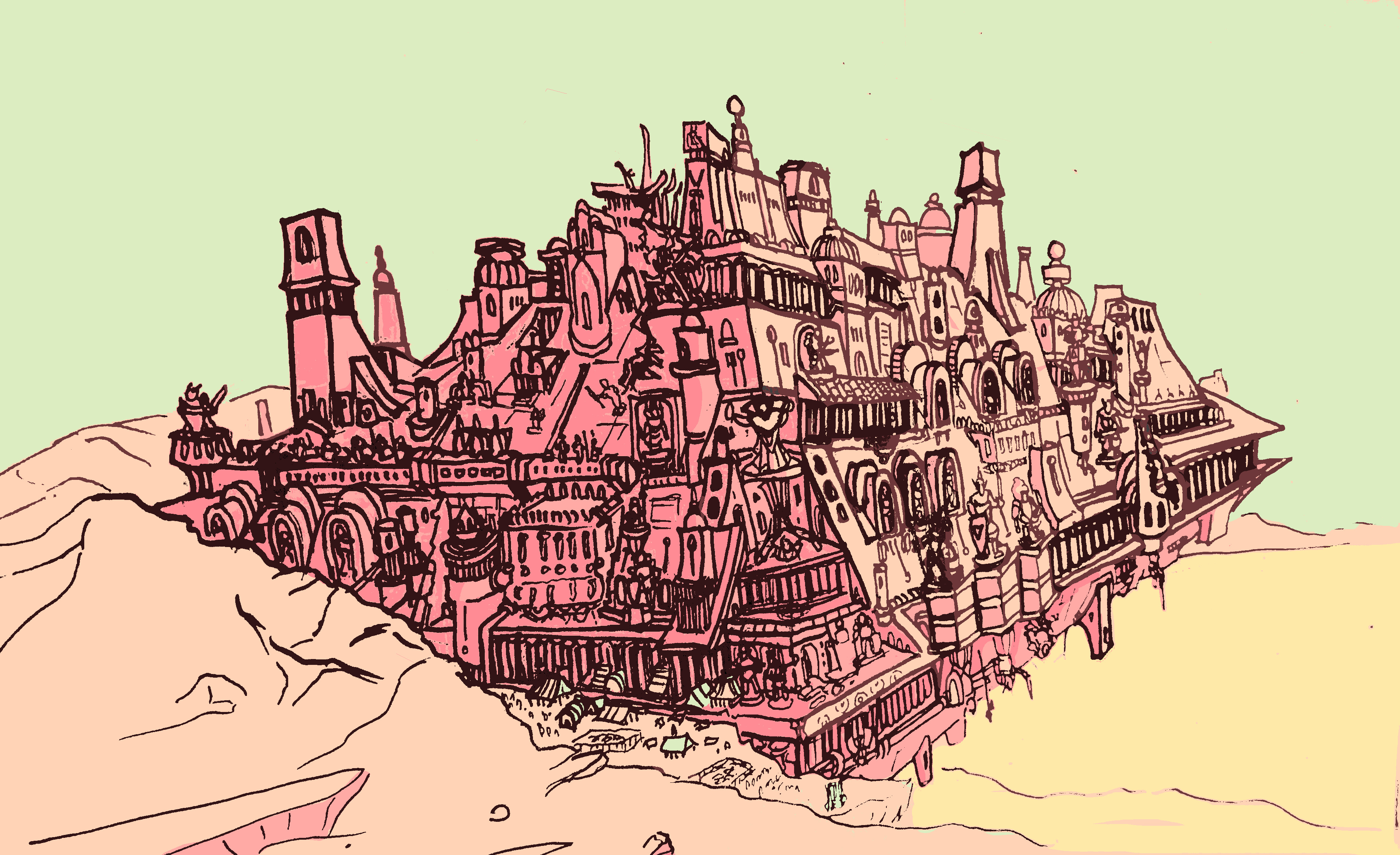
To the North and East of the Crystal Frontier, beyond the Bay of Fallen Stars or across the Maiden Tombs over the Road of Dead is the Province of Blackacre, sometimes known as the Blackmash. Grey salt marshes rising from the Silt Straights and beyond deep, wet forests of colossal evergreens and ancient malice. Blackacre was the last Imperial Province settled, and never much beyond wilderness. A wealth of lumber, fish and the rare dyes of found in the vast tidal pools along its shores provided impetus for settlement, but the climate, old sorcery and (according to heretic scholars and false prophets) the dogged resistance of the “old people'' who once lived in its forests has made it difficult to find voluntary settlers. The majority of residents in Blackacre are prisoners or the descendents of prisoners, sent to toil in the lumber towns fisheries and dye pools.Even the Imperial soldiery abhors Blackacre, long considered a dangerous punishment posting, and its 5th “Battle”, the Larks, who have been charged with Blackacres’ defense since before the rise of the Successor Empire, now exist only as a few hundred residents of canal and border forts subsisting on transit taxes. With the typical logic to Imperial governance, Blackacre, one of the few provinces that produces a surplus of wealth, trade goods, and raw materials is almost devoid of official protectors and most in need of them. The shores of Blackacre are directly across the murky shallows of the Narrow Sea from the Mud Isles … the Ghoul Kingdoms, now almost united under vile White God.

Bickering over resources between the elite of Dawn Rill and the Imperial Cult, mean that no colossi or lesser war machines have been redeployed to Blackacre, and the Cult’s fear of increasing the power of the military means that recruiting the 5th up to strength cannot even be discussed. Instead Blackacre’s coasts are protected from the raft fleets that come each autumn to reave and kidnap by penal templars. Sects of “Sword Saints”, devoted to Emperor Isacco Hydria, saint of tribulations and protector of the imprisoned, falsely accused, and repentant.

From five huge monastery-prisons, geomantically sculpted spires of sea basalt, and numerous smaller gaol hermitages, the penal templars watch the sea. An army of fanatics and felons that defend the shoreline’s dyers and fishers, but also extract dues and taxes in the form of food and raw materials. Those who have lived in the spires describe them as hellish. A cruel hierarchy, layered from top to bottom, where the newest prisoners or those of the lowest status live on a diet of kelp and barnacles in the half flooded galleries at the base. The cold seas seep and flood regularly into these dark vaults and the threat of drowning is as constant as that of the predatory gangs. Children of the galleries and the strongest fighters who survive the yearly gladiatorial contests are allowed into the dry stone above, where thousands of rock cut cells are home to a cruelly excessive creed of asceticism and martial training. When the training monks deem these unfortunates properly tempered and disciplined, they become part of the templar host, and move up to the temples, meditation halls, arenas, refractories, training halls, forges, and armories of the spire’s upper levels.

Thursday, December 29, 2022

A Fistful of Crystals

Character Generation
and House Rules for My Home Game


I'm going to be running a Crystal Frontier game online, the first semi-public game I've run since the end of G+.  In preparation rather then introduce my house rules piecemeal I've prepared a character generation and basic rules document for the game.

It includes the major subsystems for my house ruled version of Original Dungeons & Dragons (the 1974 pre-Greyhawk version, but not using Chainmail). This is the system I've used for several years and I find it works quite well for dungeon crawls. The goal is a quick, low complexity system that makes exploration a coequal element of play and can be used for online two to four hour sessions in an expedition based (each session you must leave the dungeon) campaign.

They make significant changes to the base OD&D system, though I think most of these changes fill in voids in the original rules or streamline areas where the design doesn't support contemporary games. At it's core though it should still be that same sort of D6 and D20 based flatter power curve, high lethality system as the original.

Monday, December 19, 2022

Dungeon Design, Process and Keys

DESIGNING  
FOR  DUNGEON
23
With my decision to work on Dungeon23 coincides my starting a public Crystal Frontier Campaign and being dissatisfied with the progress I've been making to various new projects. I've got three large, rather experimental dungeons about 1/4 - 1/2 finished (including art and layout), and a smaller one of about 20 rooms 2/3 done, but they've just refused to come together this year. Hopefully at least the small one will be out sometime. So I've had lots of reasons to thinking a bit about how I personally design dungeons and adventures again - not as a theoretical exercise, but because I need to write some new, satisfying dungeons.

Below are some notes on my personal quick technique for getting something together for play at my table and (after a lot of additional polishing) for publication. I hope they can be of help to newer designers thinking about giving Dungeon23 a try (or really just writing up a dungeon to crawl).  As always they are for the classic dungeon crawl style of play: exploration supported by procedural turnkeeping, supply, and randomized risk. They are likely the entirely wrong way to write an adventure that will make really good live action Youtube or help you run a Vampire the Masquerade campaign, I don't pretend to know how to do either of those things. 

NATURALISM
I’m a naturalistic, or maybe even ‘organic’ designer.

This has nothing to do with whole grains. As a style of adventure design, what I’m calling organic is an expansion of what's often described as “Gygaxian Naturalism” because Gygax discusses it in “The Campaign” section on pages 86-88 of the 1st edition Dungeon Master’s Guide. While the focus is usually on Gygax's creation of a fantasy ecology, I'd say he goes further and offers an approach to making dungeon adventures that form a logical whole.

It’s also obvious to me that this was Gygax’s personal style of adventure design, meaning naturalistic design was extremely important to the success of Dungeons & Dragons and roleplaying games more generally. Organic design shows through clearly in Gygax’s best work, his most memorable adventures such as Keep on the Borderlands (B2) and Against the Giants (G series). While these adventures might not appeal to everyone today, in praising them it’s important to look at them compared to other design options at the start of the hobby. Arneson’s original Temple of the Frog as included in the Blackmoor supplement for OD&D and Wee Warrior’s Palace of the Vampire Queen by the Kerestans are great counter examples.

The naturalism and coherence of Gygax’s adventures sets them apart, he focused on the dungeon space as interconnected by logical relationships, sometime ecological, but often political or historical. His contemporaries produced dungeons that were far closer to a board game sytle series of encounters, or as the afterthought to a larger scale political and military conflict (which Arneson did design quite naturalistically). The mead hall of Gygax’s giant chief makes sense as a location, structurally, thematically, and as an adventure. Its rooms have clear uses and a sensible layout within the larger fictional space. Its inhabitants relate to each other and have uses for the spaces they inhabit. While Gygax's dungeons are far from realistic, and can become odd at times there’s almost always a thruline of sense and purpose that can only come from the conscious effort to build a dungeon around its inhabitants and a theme. As affirmed in his Dungeon Master’s Guide, Gygax doesn’t want to overthink the logic of his dungeons as a simulation, but to create a plan and structure a location that are comprehensible to and and exploitable by the players. You can poison the giant’s stew in the Steading of the Hill Giant Chief because the kitchen and feast hall exist as part of a sensible and coherent whole—that’s Gygaxian Naturalism (though the term is also used sometimes to describe a group writing process). Jennell Jaquays, tentatively with F'Chelrak's Tomb (1976), and notably in her later adventures Caverns of Thracia and Dark Tower (less effectively), expands on Gygaxian Naturalism quite successfully. Her designs start the practice of layering history and increasing the density of description, the level of interactivity, significance of faction relationships, and spacial complexity of dungeons making them more functional for exploration.

In some circles, Gygax’s other major contribution to adventure design is more popular - procedural generation. Appendices A-H of the Dungeon Master Guide are one of the first (they date back to Strategic Review/Dragon, Issue 1 as a way to play D&D solo) efforts to define this technique - providing a means for a dungeon to build itself through random dice rolls.

I’m not much of a fan. Here’s why.

I’ll acknowledge that procedural generation can be useful as a springboard for ideas or to fill space in a hurry when nothing better is available (such as when your players move off “the map”), but randomly generated rooms are either too vague and disconnected for anything more than board game style play, or require such complex tables that the designer might as well just produce a much larger keyed adventure with the amount of space and ideas. Relying on random stocking almost always means that the details and complexity need to be filled in, and the random design expanded and rationalized. You’ll still end up describing, keying, factionalizing and connecting the parts of your dungeon for it to function well. All procedural generation does is add the step of randomly generating elements of the space that have to be revised to give the dungeon coherence.

These are the basics of what sort of dungeons I want to write. Classic keyed spaces with a high degree of coherence, interactivity, variety, a layered history (useful and discovered via clues in play), navigational puzzles, and both description and themes that go beyond those of typical Gygaxian vernacular fantasy or the contemporary expectations of standard fantasy settings.

Friday, December 9, 2022

DUNGEON23 WORKSHEETS

A DUNGEON DESIGN CHALLENGE FOR THE NEW YEAR

Sean McCoy of Mothership fame recently proposed a community challenge, event or project he calls
Dungeon23. My friend Ben L. over at Mazirian’s Garden has a bit more to say about it.  

The basic idea is to challenge yourself to write a dungeon room key each day and dungeon level a month in 2023. Come January 1, 2024 you will have a 350 room dungeon … a megadungeon.

The room keys don’t need to be fancy or extensive, and Sean suggests an extremely minimalist style, so the dungeon keying becomes a manageable habit and not a chore. I like the idea, it feels a lot like some of the challenges and community events from back in the days of Google Plus, such as these hex crawls, keyed by anyone who wanted to add a hex key -- a practice referred jokingly to as “Gygaxian Democracy” at the time.

I’m likely to give Dungeon23 a try, but unlike my aborted effort at Gygax75 -- where I discovered that what I needed for an adventuring region was very different then the project -- I’ve made the changes I want to make to the challenge to make it work better for me. I also want to help others get their own megadungeons finished, so I am sharing the series of worksheets I made and have linked them below so that anyone can use them by making a copy of the googledoc (please turn of sharing on your copy).

Sunday, September 18, 2022

Gus L. Free Adventure Archive


I've created an Archive of all the free adventures I've written since 2012 here:


FREE ADVENTURE PDF ARCHIVE

I also wrote a paragraph about each the adventures included to place them within my own design evolution and perhaps a larger story of OSR design from 2012 - 2020.

In Other NEWS Tomb robbers of the Crystal Frontier is available as a Print on demand version, on Drivethru for $16.00 (as of 9/22 - print costs change). This version includes an area map, added art and a new supplemental adventure.

Questing Beast Youtube Review

link for purchase


Thursday, June 16, 2022

PROCEDURALISM


SLOUCHING TOWARD PROCEDURALISM

“Here we come across another, very positive feature of play : it creates order, is order. Into an imperfect world and into the confusion of life it brings a temporary, a limited perfection. Play demands order absolute and supreme. The least deviation from it "spoils the game", robs it of its character and makes it worthless.”

- Homo Ludens

Homo Ludens is a foundational work in the scholarship of games or “play” and of cultural history more generally. Written by the Dutch historian Johan Huizinga and published in 1938, it defines play as a distinct natural activity that exists outside everyday survival, only for the purpose of freedom and fun. However, a major element separates play from other leisure activities
play requires rules.

Play produces “games” or what RPG communities like to call “systems”, each of which has a set of rules, even the games of animals. Huzinga’s example is dogs playing at fighting, pretending to be furious. The dogs nip and mouth each other, but never bite to injure as they would in a real conflict. Even the play of puppies has unwritten rules that fall largely into the concept of “fairplay”, exactly the same concerns that dominate human play, including RPGs. RPGs though are a complex game, and have correspondingly complex sets of rules, including unspoken ones.

Rules come in more than one variety as well, especially in complex games. In RPGs we often focus on what I differentiate as “Mechanics”; rules that largely cover how events within the fiction of the game work. What dice we roll and what they mean when the system models a fight for example. Mechanics are almost always the primary focus of rule books, because without them it’s impossible to play the game at all, or at least it’s impossible to play as a distinct system, and that’s the goal of most designers: to share their distinct vision of play with others.

Yet there’s another sort of rules. Rules about why and how we play more generally that I will call “Procedure”. Procedures are a form of rules for outside of play itself, the rules for using the rules. While mechanics define why and what is happening in a game, procedures define how it happens at the table. Procedure is the way we, the players, do something in the game.

This is a somewhat loose definition, and there’s overlap between procedures and mechanics
edge cases where rules may be both, where they serve different purposes at different times, or where it’s hard to tell which category they fit in. However, the existence of troublesome borderline rules isn’t grounds to dismiss this entire distinction, because most of the time the distinction is intuitively obvious, and more importantly it’s useful. The distinction between mechanics and procedure allows one to look at games: rules, design principles, ethics, and cultures of play in a new way, viewing what might seem like eccentricities as necessary parts of the entire rules structure, interrogating them as potential elements of intentional design. However, even with this distinction in mind the relationship between how, what, and why in a rules-based system is complex, but this complexity isn’t just for RPGs or games, similar issues appear with all complex rules-based disciplines and there are applicable tools available for a better understanding of Procedure.

I am not adapting my definitions of procedure from Huizinga, or from the theory of games at all. Instead, to dig into the meaning of Procedure, I went to theory of another rules-based structure, an older and more fiercely contested space, with far more theory around the distinction between substantive and procedural rules—legal theory.

Proceduralism is a significant approach in the theory and practice of law, and especially American jurisprudence. This may feel like an odd leap, from law to games and back, but it’s not entirely my own, it's also Huizinga’s and he makes a compelling argument that the legal system shares many elements with a game or contest.

“The judicial contest is always subject to a system of restrictive rules which, quite apart from the limitations of time and place, set the lawsuit firmly and squarely in the domain of orderly, antithetical play. [...] The lawsuit can be regarded as a game of chance, a contest, or a verbal battle.”

- Homo Ludens

Sunday, March 13, 2022

DUNGEON!, STRATEGOS, AND D&D


Stumbling Towards D&D's Alternate, Alternate Combat System
 
The combat mechanics of Classic fantasy RPGs are a huge source of both debate and game design innovation. The first official changes to Dungeons & Dragons in “Supplement 1 - Greyhawk” are changes to combat mechanics (variable Hit Dice, including weapon damage and Hit Points by class) that form a central aspect of every subsequent edition of Dungeons & Dragons. Even now D&D's combat rules continue to evolve, increasing in complexity and offering ever more variability, steadily accreting to form the 100’s of pages of rules, customization options, feats, spells and mechanics that allow the current edition to function almost as a tactical game of fantasy superpowers and feat usage.

I’m not going to catalog, debate, or mock these early design choices. Like most of early Dungeons & Dragons the combat system is entirely functional, and while, like all novel inventions it can be streamlined or optimized in various ways, it serves. Of course what’s also fascinating about the system offered in the first edition of D&D is that it’s presented as an alternate but it was adopted almost exclusively by early players, by many presumably because they didn’t own the recommended rules in Chainmail. Both Gygax and Arenson, in the Greyhawk and Blackmoor supplements, start fiddling with it almost immediately. Other groups also begin to transform Dungeons & Dragons very quickly, often starting with the combat system, but retaining its core assumptions … the deep DNA of hit points, distinct hit and damage rolls, and damage based on weapon type, can be found even in contemporary video games. The haphazard alternate combat system offered because the preferred one (at the time) was already published, too lethal (per Arneson), and too complex to include in the modest booklets of early D&D, has become the model for the majority of mechanics in role playing games -- your Fromsoft console protagonist still fights like a 1970’s tabletop ironclad, battered into sinking by enemy blows.

Old Games

Let’s talk about old tabletop roleplaying games - specifically the kind of games played in the 1980’s and recently depicted in the nostalgia...